In 2025 Thailand recorded 416,574 births and 559,684 deaths [3]. That is a natural population decrease of roughly 143,000 in a single year, more deaths than births, with the births the lowest in about 75 years and under half a million for the second year running. Mahidol University’s latest population gazette estimates the national fertility rate at about 0.86, roughly Singapore’s level and deep in East Asia’s ultra-low-fertility basement, far under the 1.20 the United Nations still records for Thailand [1][4]. Demographics is supposed to be the slow, predictable layer beneath the fast noise of trade and tariffs. In Thailand it just did the thing the slow layer is not supposed to do. It surprised on the downside.
Two things follow, and they are the spine of this brief. First, for the fastest-ageing ASEAN economies the UN medium variant looks less like a neutral planning line than the benign case, and the latest national data is testing even that. Second, and worse for anyone with a supply chain, the downside risk is concentrated in the countries with the factories. The young workers and the working factories are not in the same countries. This first brief takes the demographic baseline and its clearest asset-market consequence, housing; two companion briefs, on growth and productivity and on who carries the cost inside an ageing society, will follow. The Regional Demographics dashboard turns the UN WPP age-sex structures into a live planning layer: median age, fertility, working-age share, old-age dependency, and derived cohort overlays such as prime home-buyers and elderly population growth. It refreshes with each WPP revision, and is used here as a stress-testing tool, not as a replacement for the underlying statistical sources [1][2].
The forecast is the optimistic case in practice
Set the two fertility numbers side by side, the UN’s 1.20 and Mahidol’s 0.86, and you have the measurement problem in one country. They are not two readings of the same object: the UN series is harmonised and smoothed for cross-country comparability, while the national gazette is closer to the raw domestic shock, and for planning the gap between them is the point [1][4]. Either figure is far under the 2.1 a country needs to replace itself, and Thailand has been beneath that line since the early 1990s, so the shortfall is not a forecast. Most of the 2050 workforce is already alive; fertility policy can change the second half of the century, but it cannot refill the 2040s.
And the UN’s number may not just lag, it may be built high. UN projections assume that very low fertility eventually recovers toward a floor, the family of assumptions Basten, Coleman and Gu warned about, borrowed from European experience and a poor fit for advanced East Asia, where the national agencies project lower and the demographers saw no near-term rebound [5]. Thailand’s own medium path embodies it, with fertility drifting back up to 1.29 by 2050 [1]; the latest registry data gives that rebound little comfort. The honest caveat, that 0.86 is a period rate depressed by postponed births so completed families will settle somewhat higher, does not rescue the forecast. The UN medium variant is not optimistic by design, but in Thailand it increasingly looks optimistic in practice: a projection betting on recovery, set against a country whose births just hit a 75-year low for the second year running, should be read less as the safe central case than as the benign side of the planning envelope.
The arithmetic that is not in doubt is the part already locked in. Thailand’s median age rises from 40 to nearly 49 by 2050. Its working-age population, the 15-to-64 group that staffs the factories foreign buyers care about, falls from 50.1 million to 39.1 million [1], eleven million workers gone, more than a fifth of the labour force. No fertility policy can refill it in time; the levers that remain are participation, migration, productivity, later retirement, and automation. The total population already passed its peak, near 71.7 million around 2024.
| Thailand | 2024 | 2050 |
|---|---|---|
| Total fertility rate | 1.20 (UN); 0.86 (national) | 1.29 (UN medium) |
| Median age | 40.1 | 48.6 |
| Working-age population (15–64) | 50.1M | 39.1M |
| Old-age dependency (per 100 of 15–64) | 22 | 50 |
| Population | 71.7M (at peak) | 66.4M |
The births and deaths cited above are civil-registration totals from the Department of Provincial Administration; the 71.7M population and the age-structure projections are UN World Population Prospects, a different and internationally comparable measurement universe. This brief uses the national vital statistics for the latest shock and WPP for cross-country age structure.
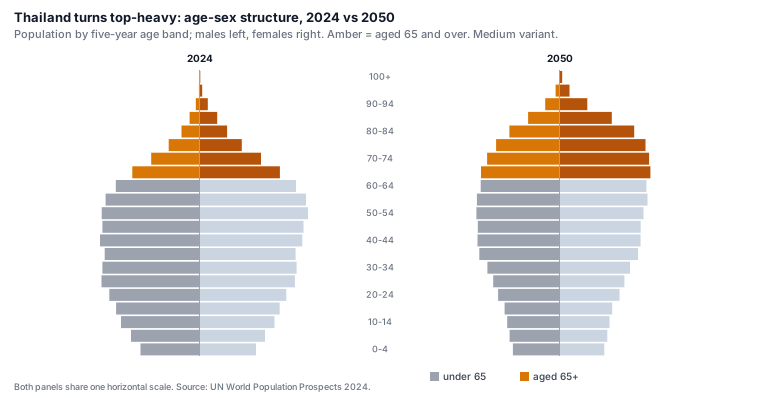
Thailand reaches all of this as an upper-middle-income country on the World Bank’s 2024-25 scale [6], ageing before it built the fiscal cushion Japan or Singapore had when they entered the same phase. It grew old before it grew rich, the ageing-before-rich path China walked first. What is new is the speed: the registry is already pressing below the line most planners still treat as central.
Thailand is the sharpest break, but it is no longer alone, and the pattern is asymmetric rather than uniform. Singapore’s resident fertility fell to 0.87 in 2025, below the 0.95 the UN carries [20]. The Philippines, still sold as the young hybrid of ASEAN, recorded a 2025 survey-period fertility rate of 1.7, under the UN’s 1.89 [21]. Malaysia has not dropped below the UN line, its 2024 rate was 1.6 against the UN’s 1.54, but its births fell 9 percent in a single year to a four-decade low [22]. Brunei’s births dropped sharply in 2024, though its fertility comparison is less clear. And Vietnam is the exception that makes the point: at 1.91 in 2024 it sits right on the UN’s 1.90 line, not beneath it, with urban fertility already down at 1.67 [23]. The lesson is not uniform collapse. It is country-specific downside risk, clustered uncomfortably close to the economies buyers actually use, which is why a sourcing decision needs demographic stress-testing country by country, not a single “ageing Asia” headline.
The factory half is the ageing half
Put the eleven Southeast Asian economies in a row, sort them by fertility, and the bloc separates into two groups facing opposite futures. Below replacement, where ageing is locked in: Singapore at 0.95, the lowest in ASEAN on the UN’s basis; Thailand at 1.20 by that measure and 0.86 by its own; Malaysia at 1.54; Brunei at 1.73; the Philippines at 1.89; and Vietnam at 1.90 [1]. Above the line, with workforces still growing into the 2040s: Indonesia at 2.11, Myanmar at 2.10, Laos at 2.40, Cambodia at 2.55, and Timor-Leste at 2.63 [1]. Singapore’s headline de-facto numbers understate its resident ageing: the UN count includes over a million young migrant workers, so the resident median age is 42.8, not 35.7 [1][7].
I would not lean too hard on that second group. Indonesia and Myanmar clear replacement by a tenth of a child. The operating version, the one that matters for a sourcing decision rather than a headline, sorts the eleven into four tiers: Singapore and Thailand ageing fastest; Vietnam and Malaysia below replacement but younger and still deepening industrially; Indonesia sitting on the line as the giant; and a genuine frontier with years of runway left, Cambodia, Laos, Timor-Leste, and a near-replacement Myanmar. The Philippines is the interesting hybrid, already under replacement, 1.89 on the UN’s medium line and 1.7 on the 2025 survey, yet still young, a median age of 25.7 [1][21]. The two-way split is the warning; the four-tier split is the sourcing model.
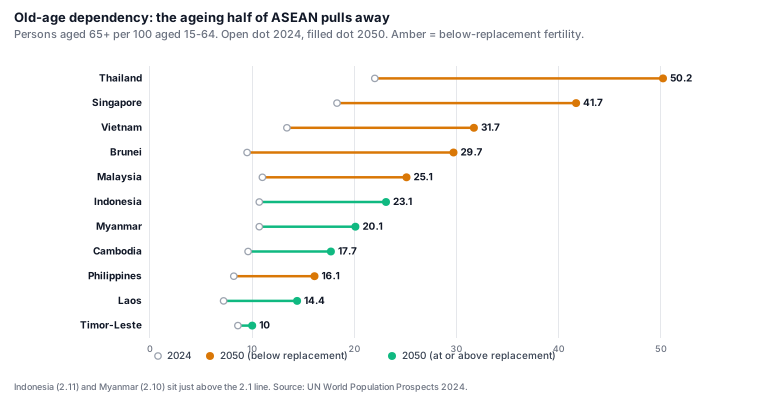
Here is why it matters past the seminar room. The corporate move of the past decade is China-plus-one: keep some production in China, add a second base in Southeast Asia to hedge cost and tariff risk. The unspoken assumption is that ASEAN is the young alternative to an ageing China. It only half-holds. The mature, capable supply bases, the ones with the roads, ports, supplier networks, and trained workforces buyers actually want, are Thailand, Vietnam, Malaysia, and in some sectors Indonesia. The first three are precisely the ones on the ageing track, two of them on China’s own fertility slope a decade behind. The fastest-growing labour forces are in the frontier economies where the industrial base is thinnest. The young workers and the working factories are not in the same countries, and choosing between cheap young labour and a deep industrial base, rarely both, is the real China-plus-one decision, not the median age. Price the trajectory: a plant sited in Thailand for cheap labour sits in a market losing more than a fifth of its working-age population over the life of the investment, on the same curve as the China it was meant to hedge. Vietnam’s loss is milder and comes later, but the direction is the same, and sharper in the urban industrial centres that matter most.
What it does to property
Take the demographics somewhere concrete, into the asset most households hold. Housing demand is age-structured: households form and buy in a narrow band, roughly 25 to 44, so the cohort that drives a property market is countable, and its future is already sitting in the pyramids. I ran our layer for it, and the 25-to-44 cohort moves brutally unevenly across ASEAN by 2050. What follows is a measure of demographic pressure, not a price prediction: a cohort-pressure indicator, a way of asking whether the household-forming pool is growing or shrinking before credit, supply, migration, and policy intervene.
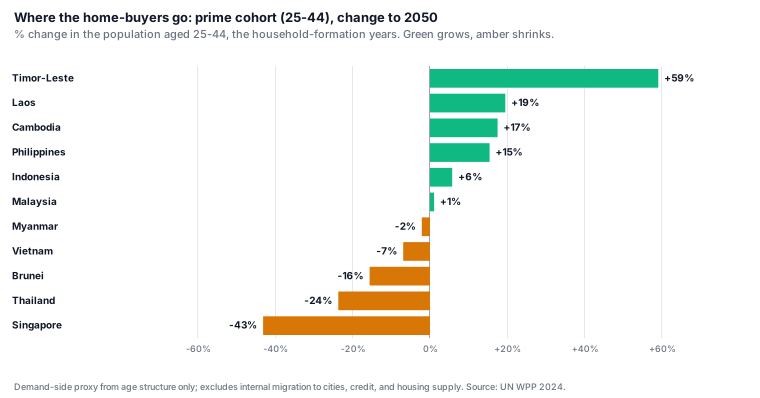
Singapore loses 43 percent of its prime buyers by 2050 and Thailand a quarter [1][2]. The Philippines and the frontier add double digits. Underneath sits a second number: the population over 70 at least doubles in every ASEAN country, the young ones included, so aged-care housing and the slow release of the homes the old leave behind is the one property story common to the whole bloc. Ownership rates, mortgage credit, and family transfers still differ too much across these countries for one cohort to carry the whole argument.
The literature gives this a direction and a discipline. Előd Takáts found, across 22 advanced economies, that ageing will subtract around 80 basis points a year on average from real house prices over the next four decades relative to neutral demographics, with the drag near that figure in the United States and stronger in Europe and Japan, a persistent headwind rather than a crash [8]. The discipline is the cautionary tale: in 1989 Mankiw and Weil built the age-structured housing model everyone still uses, then predicted US prices would fall 47 percent by 2007 [9]. They were wrong, because cheap credit, immigration, and supply overwhelmed the demographic signal for two decades. Demographics sets the direction of housing demand and never the price on its own.
Two cases bracket the divergence. Japan is the ageing end: roughly nine million vacant homes, about 14 percent of the stock, central Tokyo at record prices while rural homes change hands for token sums [10]. Ageing does not lower a national average evenly; it hollows the weaker regions while concentrating value in the core cities. That is the spatial risk Thailand’s and Vietnam’s secondary regions need to price. Thailand is already living the early version in its condominium market: Chinese buyers cooling, down about 12 percent in 2024 though still the largest foreign group, while Myanmar buyers tripled into second place, money fleeing domestic turmoil [11]. A shrinking domestic buyer base in parts of the urban condo market, propped up by money from somewhere else. In that segment, at least, this is not a forecast. It is the current weather.
Property is only one consequence, and I have kept it whole here because it is the most measurable. Two others deserve their own briefs, and will get them. The first is what ageing does to growth itself, not just the headcount but the productivity and the dynamism, the evidence that an older society invents less, starts fewer firms, and slows down, and whether automation lets a middle-income economy escape that or whether it deindustrialises before it is rich. The second is who carries the cost inside an ageing country, the shrinking working-age cohort wired between its parents and its children, the thin pension net, and the family safety net fraying alongside the fiscal one. Both are coming.
The boring reforms become less boring
This is where demographics starts to touch policy, and the dull arguments stop being dull. Thailand’s housing debate is the first example. The foreign condominium quota, still capped at 49 percent of a project’s saleable area, was written for a different demand structure; in 2024 the cabinet ordered a study of raising it toward 75 percent, and asked the Interior Ministry to weigh longer foreigner leaseholds, toward 99 years [24]. Neither is law, and demographics does not make either reform automatically right: affordability, speculation, building control, and the politics of land all still matter. But it changes the question. In a market where the domestic household-forming cohort is shrinking, foreign demand stops being a luxury-market distortion and, in some cities and segments, becomes part of the demand floor.
The same logic runs regionally. ASEAN has spent years speaking the language of a single production base and freer movement of skilled labour, with Mutual Recognition Arrangements covering a limited set of professions, from engineering to accountancy; their implementation has been, in the title of one ADB and Migration Policy Institute review, a long road ahead, slow and uneven [25]. The demographic map gives that unfinished agenda a harder purpose. The factories, ports, and supplier networks sit in the countries whose workforces are ageing; the younger workers are in the countries where the industrial base is thinner. The answer is not fantasy open borders. It is narrower and duller: faster credential recognition, factory-linked training corridors, legal work-permit channels, and investment that wires frontier labour pools to mature industrial ecosystems.
Demographics does not dictate these reforms. It raises the cost of avoiding them. If Thailand, Vietnam, Malaysia, and Singapore age into labour scarcity while Indonesia, the Philippines, and the frontier fail to convert their younger cohorts into productive work, ASEAN gets the worst of both worlds, old factories and underused workers, and China-plus-one stops being a hedge and becomes a sorting problem. The fiscal half of that, who pays for the old, and the growth half, whether automation and skills can keep the agers productive, are where the next two briefs go.
Is there hope at the other end
Yes, and not the lazy kind. The young ASEAN countries are not promised a boom because they have young people; that is the cheerful error. The honest case is the conditional demographic dividend, and the people who built that theory aimed it straight here. Bloom and Williamson showed that as much as a third of the East Asian growth miracle was demographic, and that the tailwind would fade in East Asia and shift to Southeast and South Asia [12]. Bloom, Canning and Sevilla were equally clear that it is a window, not a gift: it pays out only where the schooling, the health system, the labour market, and the institutions exist to put the young to work [13]. Wolfgang Lutz sharpened it to one variable, that the dividend is really an education dividend, converted by the countries that school their young and wasted by the rest [14].
And the clouds are gathering on schedule. Indonesia’s demographic bonus is projected to peak around 2030 and then close [15], which is why its prime buyer cohort grows only 6 percent. The Philippines’ own population commission warns that only three of its seventeen regions, the capital, CALABARZON, and the Cordillera, are ready to capture the dividend, and job creation is trailing the cohort arriving into the labour market [16]. The World Bank’s framing is the honest knife: a youth bulge is a dividend or a bomb depending on whether the jobs arrive [17]. And the same automation that might let an ageing economy grow through scarcity [18] can erode the cheap-labour rung the frontier is counting on, the premature-deindustrialisation worry [19]. By 2100 the UN’s variants fork hard, Thailand running anywhere from 30 million to 66, the Philippines from 72 to 171, Indonesia from 195 to 430 [1]. Thailand’s latest fertility sits well below the UN medium path, which makes the lower part of its projection fan the relevant one for stress-testing, not the comfortable middle.
I began with Thailand’s births and deaths, and I will end on what they taught me. Demographics is the slow layer, the one that almost never surprises, which is why it is easy to ignore beside the fast noise of tariffs and freight. Thailand is the reminder that it can still surprise, and that the surprise can run darker than the forecast. But naming the dark is the easy part, and acknowledging it does not, on its own, make anything better. The 2050 workforce is already born and the divergence inside ASEAN is already set; the only open questions are the ones policy can still answer, whether the ageing half automates in time, and whether the young half educates and employs its bulge before the window shuts. That is where the work is, and it is why I land on cautious optimism rather than gloom: the ageing half is running out of choices, but the young half still owns its number, the chance to make 2050 a decision rather than a prediction. The clouds are real and they are not far off. Thailand is the warning the rest of the region still has time to read.
References
[1] United Nations, Department of Economic and Social Affairs, World Population Prospects 2024. Primary source for demographic figures unless otherwise noted: fertility, median age, working-age share, old-age dependency, age-sex structures, and the low/medium/high projection variants. https://population.un.org/wpp/
[2] A1AYN, Regional Demographics dashboard. A derived analytical layer built on the UN WPP 2024 age-sex structures, not an independent statistical source: live median age, fertility, working-age share and old-age dependency for 175 countries, plus the prime-buyer and elderly-cohort overlays used here. The underlying demographic figures should be read against UN WPP 2024 [1]. https://a1ayn.com/data/demographics/
[3] Thailand Department of Provincial Administration (Ministry of Interior), 2025 civil-registration totals, reported by the Bangkok Post (February 2026). 416,574 births against 559,684 deaths in 2025, the births the lowest in about 75 years and a natural decline of roughly 143,000. https://www.bangkokpost.com/thailand/general/3196723/thailand-pushes-to-arrest-plunging-birth-rate
[4] Mahidol University, Institute for Population and Social Research, Population Gazette 2026 (January 2026). Estimates a national total fertility rate of about 0.86, far below the UN WPP estimate of 1.18 to 1.20; the Department of Provincial Administration’s 2025 civil-registration totals (416,574 births against 559,684 deaths) are consistent with an ultra-low-fertility picture. https://ipsr.mahidol.ac.th/en/population-gazette/
[5] Stuart Basten, David Coleman and Baochang Gu, Re-examining the fertility assumptions in the UN’s World Population Prospects: fertility recovery in East Asia? (2012). Argues the UN’s assumed recovery of very low fertility toward a floor is drawn from European experience and is not justified for advanced East Asia, where national statistical agencies project lower. https://doi.org/10.2139/ssrn.2275938
[6] World Bank, Country classifications by income level, 2024/2025. Thailand, Indonesia and Malaysia upper-middle-income; Vietnam and the Philippines lower-middle-income. https://blogs.worldbank.org/en/opendata/world-bank-country-classifications-by-income-level-for-2024-2025
[7] Singapore Department of Statistics, Population in Brief 2024. Resident median age 42.8 and resident fertility below the de-facto figure; residents aged 65-plus at 18.0 percent. https://www.population.gov.sg/files/media-centre/publications/Population_in_Brief_2024.pdf
[8] Előd Takáts, Ageing and Asset Prices (BIS Working Paper 318, 2010); Aging and house prices (Journal of Housing Economics, 2012). Using BIS real house price data for 22 advanced economies (1970-2009) with UN population projections, ageing is estimated to lower real house prices on average by around 80 basis points a year over the next 40 years relative to neutral demographics, around 80 bp in the United States and stronger in Europe and Japan. https://www.bis.org/publ/work318.pdf
[9] N. Gregory Mankiw and David N. Weil, The Baby Boom, the Baby Bust, and the Housing Market (NBER Working Paper 2794, 1989; Regional Science and Urban Economics, 19, 235-258). The age-structured housing-demand model, and the famous over-prediction of a 47 percent real price fall, later documented as not occurring (Federal Reserve Bank of San Francisco, Housing Markets and Demographics, 2005). https://www.nber.org/papers/w2794
[10] Japan Ministry of Internal Affairs and Communications, 2023 Housing and Land Survey (reported via Nippon.com). A record 9.0 million vacant homes, 13.8 percent of the stock, with Wakayama and Tokushima worst at 21.2 percent, against record-high prices in central Tokyo. https://www.nippon.com/en/japan-data/h01987/
[11] Real Estate Information Center (REIC), Thailand, condominium transfers to foreigners 2024 (reported via Bangkok Post). Myanmar buyers tripled in the first nine months of 2024 to second place behind China (over 1,000 units, 5.46 billion baht); Chinese transfers down about 12 percent, Russian down 16.8 percent. https://www.bangkokpost.com/property/2905528
[12] David E. Bloom and Jeffrey G. Williamson, Demographic Transitions and Economic Miracles in Emerging Asia (NBER Working Paper 6268, 1997; World Bank Economic Review, 1998). Up to a third of the East Asian miracle was demographic, with the tailwind expected to shift to Southeast and South Asia. https://www.nber.org/papers/w6268
[13] David E. Bloom, David Canning and Jaypee Sevilla, The Demographic Dividend: A New Perspective on the Economic Consequences of Population Change (RAND, 2003). The dividend is a conditional window, not an automatic outcome. https://www.rand.org/pubs/monograph_reports/MR1274.html
[14] Wolfgang Lutz et al., Education rather than age structure brings demographic dividend (Proceedings of the National Academy of Sciences, 2019; Wittgenstein Centre). The dividend is, in effect, an education dividend. https://pubmed.ncbi.nlm.nih.gov/31182606/
[15] UNFPA Indonesia, with BPS-Statistics Indonesia and Bappenas, Harnessing Indonesia’s Demographic Dividend. The working-age window is open to about 2030, when the working-age-to-dependant ratio peaks, after which the bonus declines. https://indonesia.unfpa.org/en/news/harnessing-indonesia%E2%80%99s-demographic-dividend
[16] Commission on Population and Development (Philippines) and University of the Philippines Population Institute. Only three of seventeen regions, the National Capital Region, CALABARZON, and the Cordillera, assessed as ready to capture the demographic dividend, ranked by support ratio. https://cpd.gov.ph/uppi-prof-phls-window-on-demographic-opportunity-closing-fast-only-3-out-of-17-regions-are-ready-to-benefit-from-economic-dividends/
[17] World Bank, Youth Bulge: A Demographic Dividend or a Demographic Bomb in Developing Countries? The conditional framing: a young age structure pays off only if the jobs arrive. https://blogs.worldbank.org/en/developmenttalk/youth-bulge-a-demographic-dividend-or-a-demographic-bomb-in-developing-countries
[18] Daron Acemoglu and Pascual Restrepo, Secular Stagnation? The Effect of Aging on Economic Growth in the Age of Automation (American Economic Review: Papers & Proceedings, 2017) and Demographics and Automation (Review of Economic Studies, 2022). Faster-ageing economies adopt automation faster and show no simple negative aging-growth relationship. https://www.aeaweb.org/articles?id=10.1257/aer.p20171101
[19] Dani Rodrik, Premature Deindustrialization (Journal of Economic Growth, 2016). Automation and trade can erode the labour-intensive manufacturing rung earlier developers climbed, shortening the runway for late industrialisers. https://drodrik.scholar.harvard.edu/publications/premature-deindustrialization
[20] Singapore Department of Statistics, Total Fertility Rate 2025. Resident TFR of 0.87 in 2025, down from 0.97 in 2024. https://www.singstat.gov.sg/news/total-fertility-rate-2025
[21] Philippine Statistics Authority, 2025 National Demographic and Health Survey (key indicators). Total fertility rate of 1.7 for the three years preceding the survey, down from 1.9 in 2022; urban 1.5, rural 2.0. https://psa.gov.ph/content/fertility-steadily-declines-results-key-indicators-2025-national-demographic-and-health
[22] Department of Statistics Malaysia (DOSM), Vital Statistics Malaysia 2025. 2024 total fertility rate 1.6 (down from 1.7); live births 414,918, a 9.0 percent fall from 2023 and the lowest in over four decades. https://www.dosm.gov.my/portal-main/release-content/vital-statistics-malaysia-2025
[23] General Statistics Office of Vietnam (GSO), 2024 population change survey (reported via VOV). Total fertility rate 1.91 in 2024, a record low, against the UN’s 1.90; urban fertility 1.67, rural 2.08. https://vovworld.vn/en-US/news/vietnams-total-fertility-rate-hits-record-low-1361777.vov
[24] Bangkok Post, Foreign condo ownership quota being reviewed (2024). In 2024 the Thai cabinet ordered a study of raising foreign condominium ownership from 49 percent of a project’s usable area toward 75 percent, and to weigh longer foreigner leaseholds, widely discussed as moving toward 99 years; neither was enacted as of mid-2026. https://www.bangkokpost.com/business/general/2815396/foreign-condo-ownership-quota-being-reviewed
[25] Asian Development Bank and Migration Policy Institute, The Long Road Ahead: Status Report on the Implementation of the ASEAN MRAs on Professional Services. Mutual Recognition Arrangements cover a limited set of professions (engineering, nursing, accountancy and others); implementation across member states has been slow and uneven. https://www.migrationpolicy.org/research/long-road-ahead-status-report-implementation-asean-mras-professional-services
Explore the data: the regional split, the new housing-demand overlay, and the medium-line projections for every country are live on the Regional Demographics dashboard.
Demographic figures are UN World Population Prospects 2024, medium variant unless a low or high variant is named; estimates run through 2024 and later years are projections. Cohort and prime-buyer figures are derived from the WPP age-sex structures and refresh with each WPP revision. Current as of June 2026.