In May 2024, Gasgrid Finland published a map. A hydrogen pipeline running up the west coast, from the industrial south through Vaasa and Kokkola to Sea Lapland, more than 1,000 kilometres of new steel, a multi-billion-euro bet that Finland’s cheap wind could be turned into molecules and sold to Germany [1][2]. It is the kind of bold, infrastructure-first opening Finland has needed ever since the subprime meltdown, an imported American hangover we caught off Wall Street, last froze our nerve. I want to applaud it, and I do. We need the people who draw big maps, and right now we need them badly. The one thing we cannot afford is to mistake a bold map for a sound one.
Then I went looking for the buyer.
A pipeline is not a vision. It is a promise about molecules: that someone upstream will make hydrogen, someone downstream will pay for it, and the gap between them is worth filling with a regulated asset that lasts forty years. The figures in this piece refresh on two A1AYN pages, the electricity-costs dashboard [3] and the hydrogen-pipelines map [4], and the more I read of the demand side, the more the map looked like an answer to a question nobody has actually asked yet. This is written on 2 June 2026, and on that date the honest position is: the supply story is real, the financing story is clever, and the demand story is missing.
The plan, and what it actually commits to
There are three projects stacked on top of each other, and they are easy to conflate.
The first is the national network: Gasgrid’s own onshore line, more than 1,000 km up the Bothnian coast. The route was specified further in August 2025, and the environmental impact assessment phase is underway [5]. The intended investment decision is around 2026, with an open hydrogen market targeted for the early 2030s [1]. Early reporting put the national line at about €3.5bn [2]. By late 2024 Gasgrid was describing roughly €5bn for hydrogen transport infrastructure, with storage adding a further €2–5bn on top [6]. The number is not getting smaller.
The second is the Nordic-Baltic Hydrogen Corridor: roughly 2,500 km from Finland through Estonia, Latvia, Lithuania and Poland to Germany, designed to move about 2.7 million tonnes of hydrogen a year by 2040. It received EU Project of Common Interest status in April 2024 and Connecting Europe Facility money for a feasibility study that runs to spring 2027 [7].
The third is the Baltic Sea Hydrogen Collector: about 1,250 km of subsea pipe linking Finland and Sweden to Denmark and Germany, also a PCI, awarded €15.3 million in CEF funding in January 2025 [8].
If you count project geography rather than committed steel, Finland is now implicated in something close to 4,750 kilometres of proposed hydrogen pipeline. Notice the verb tense in every official document: intends, plans, targets, is studying. Kilometres that have passed a final investment decision: zero. Kilometres built: zero. The vehicle is real, a dedicated subsidiary called Gasgrid Vetyverkot Oy, sitting under the state-owned TSO [9]. The pipe is not.
The politically convenient ambiguity is that every kilometre sounds like progress, even when the kilometre belongs to a study, a corridor, a PCI application, an EIA route or a market consultation rather than to a funded construction project. That is why the verb tense matters. Finland is not yet building a hydrogen backbone. It is building the institutional conditions under which one might later be built: information packages, connection principles, market models and capacity surveys [10]. As recently as January 2026, the corridor’s promoters were still running a Call for Interest, asking producers and consumers for indicative, non-binding input, with the stated aim of one day signing non-binding letters of intent [11]. You do not run a call for interest for a market you already have.
The molecule that nobody has agreed to buy
A transmission pipeline needs two things at its ends: someone injecting hydrogen and someone withdrawing it. So who?
On the production side, there is genuine motion. P2X Solutions opened Finland’s first industrial-scale electrolyser, 20 MW at Harjavalta, in 2025 [12]. Nordic Ren-Gas has an e-methane portfolio across Tampere, Lahti and other sites, a Gasum offtake agreement and an EIB financing framework of up to €230m approved in late 2025, with final investment decisions expected across 2026 and 2027 [13]. Koppö Energia in Kristinestad has €85m of EU Innovation Fund money and a building permit for an e-methanol plant [14].
Look closely at that list and the problem appears. Ren-Gas and Koppö do not want to ship hydrogen. They consume it on site, combining it with captured CO₂ to make e-methane and e-methanol, products that travel in existing infrastructure. They are reasons to build electrolysers next to a heat sink. They are not reasons to build a 1,000 km hydrogen highway.
And the projects that would have fed a highway, the big merchant hydrogen and ammonia plants, are exactly the ones falling over:
| Project | Scale | Status, mid-2026 |
|---|---|---|
| P2X Solutions, Harjavalta | 20 MW electrolysis | Operating since 2025 [12] |
| Nordic Ren-Gas (Tampere, Lahti, others) | e-methane, EIB up to €230m | Advancing; FID expected 2026–2027; uses H₂ on site [13] |
| Koppö Energia, Kristinestad | e-methanol, €85m Innovation Fund | Permitted; uses H₂ on site [14] |
| Blastr Green Steel, Inkoo | ~€4bn green steel | Financing rounds ongoing; no confirmed FID [15] |
| Plug Power (Kokkola, Kristinestad, Porvoo) | 2.2 GW electrolysis | Sponsor lost ~$2.1bn in 2024; no FID [16] |
| SSAB, Raahe | existing steelworks | Last step in its conversion roadmap; a planned Raahe H₂ plant was shelved [17] |
| Flexens, Kokkola | ~€700m H₂/ammonia | Bankrupt, 2 June 2025 [18] |
The Flexens collapse is the one to sit with. Billed as Finland’s largest planned hydrogen and ammonia plant, its Kokkola project company went bankrupt on 2 June 2025, and even its completed environmental-assessment paperwork could not be turned into a going concern [18]. A year to the day before I am writing this, the flagship merchant-hydrogen project in the country failed that completely.
The wider picture is not kinder. Plug Power, the sponsor behind 2.2 GW of announced Finnish electrolysis, lost about $2.1bn in 2024 and has spent two years managing liquidity warnings; none of its Finnish capacity has reached a final investment decision [16]. Blastr Green Steel’s ~€4bn Inkoo plant has run financing rounds but announced no FID [15]. And the most telling retreat is SSAB’s: the Raahe steelworks is the last stop on its conversion roadmap, after Luleå and Oxelösund, and a separately planned hydrogen-production plant at Raahe was abandoned after the parties could not find a commercial arrangement [17]. The one piece of dedicated Finnish hydrogen-for-steel that had a serious industrial sponsor is the piece that got cancelled.
Across the EU the pattern repeats. The IEA’s 2025 review puts low-emissions hydrogen at under 1% of global hydrogen production despite the wave of announcements, with built electrolysis only a fraction of what was promised [19]. Europe announced a hydrogen economy. What it has actually built is still tiny next to the map.
Even in Finland, the arithmetic is not friendly
Here is where I expected the Finnish case to redeem itself, because the supply side really is exceptional. Finland passed roughly 9,500 MW of wind capacity in 2025, having added more than 1,000 MW in that year alone [20]. Olkiluoto 3, the 1.6 GW reactor at full output since 2023, dropped the wholesale floor through the floor: the A1AYN electricity-costs dashboard records a Finnish wholesale average of about €40.5/MWh in 2025, among the lowest in Europe, with 447 negative-price hours and a grid that is roughly 95% fossil-free [3]. If green hydrogen is going to pencil anywhere, it is here.
And yet the same dashboard marks Finnish hydrogen not viable on its own heuristic, which asks for wholesale power below €30/MWh before electrolytic hydrogen clears [3]. Why, when power is so cheap?
Do the arithmetic yourself. An electrolyser needs roughly 55 kWh of electricity per kilogram of hydrogen. At €40.5/MWh, the electricity alone costs about €2.2/kg. That is genuinely competitive with grey hydrogen made from cheap natural gas, which runs around €1.5 to €2.5 per kilogram [28]. But electricity is the one input Finland has solved. The European Hydrogen Observatory’s latest country-level data still places European electrolytic hydrogen several euros per kilogram above fossil hydrogen, roughly €4.3 to €10.5 depending on conditions [28]. At 2025 European gas prices, grey hydrogen sits around €5. So the €2.2 of Finnish electricity is the cheap part. The rest of the green stack, electrolyser capital, utilisation, grid fees, water, compression, storage, financing, is what holds green hydrogen above the fossil benchmark, and Finnish wind does nothing for any of it.
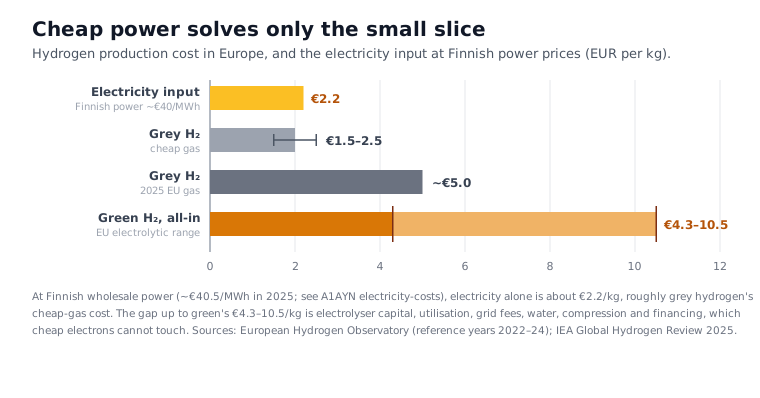
Put plainly: Finland’s wonderful power gets electrolytic hydrogen into the game at about the cost of grey hydrogen’s cheap-gas baseline, and no further. It does not make pipeline-scale merchant hydrogen automatically bankable, because the expensive part of the molecule is the part Finland’s wind cannot reach. Cheap electrons are necessary and nowhere near sufficient.
Ship the product, not the molecule
There is a deeper objection, and the advancing Finnish projects are quietly making it for me.
Suppose you have cheap power in Finland and a customer in Germany. You have two options. Move the hydrogen, or move the thing you would have made with the hydrogen. Pipelines look cheap per kilogram, the European Hydrogen Backbone puts large-pipe transport at €0.11 to €0.21 per kg per 1,000 km, but that headline assumes repurposed natural-gas pipe, about 69% of the backbone by their own design [21]. Finland would be building new, at the expensive end, and the EHB’s own roadmap carries tens of billions of euros of capex for the wider network [21].
Now look at what the projects that are actually moving have chosen. Ren-Gas does not need a national hydrogen highway to make e-methane. Koppö does not need one to make e-methanol. HYBRIT did not wait for one to make fossil-free steel in Luleå, it built dedicated wind and an electrolyser next to the furnace. These are not anti-hydrogen examples. They are hydrogen examples that weaken the case for building the long pipe first. The IEA’s trade analysis points the same way: what crosses borders economically is ammonia, methanol, hot-briquetted iron, the derivatives, not pure hydrogen down a long new pipe [19]. The logic is almost embarrassingly simple. Build the molecule where the electrons are, then ship the high-value product. VTT has argued North Ostrobothnia alone could supply 10% or more of the EU’s zero-emission hydrogen by 2030 [22], but that vision is about domestic production clusters feeding Finnish industry, not an export artery to the continent. The cheap-power advantage is an argument for putting the factory in Finland. It is not obviously an argument for putting the pipeline under the Baltic.
Who pays if the buyer never comes
This is the part that returns me to where I started, to the worry that this is the old logic in a green coat.
Gasgrid is a regulated transmission operator. It does not sell hydrogen at a market price; it builds an asset and recovers the cost through regulated tariffs, set under a regulated-asset-base framework that the Finnish Energy Authority, Energiavirasto, oversees [23]. For hydrogen, the EU’s new gas-market regulation, 2024/1789, introduces an explicit tool called inter-temporal cost allocation: because there are very few users in the early years, the regulation lets the operator recover the cost over decades so that early users “are not disproportionately burdened” [24]. Read that sentence again. The mechanism for making a near-empty pipeline financeable today is a regulatory promise that future users will pay for it.
That is an elegant solution to a real chicken-and-egg problem. It is also a precise restatement of my original worry. If the anchor demand arrives, inter-temporal allocation is just sensible smoothing. If it does not, the question is who holds the asset. The candidates are unattractive: future hydrogen users, who inherit tariffs sized for a build that assumed more of them; existing natural-gas customers, if any cost is socialised across the wider network; or the Finnish taxpayer, because Gasgrid is 100% state-owned and the equity is public money. Finland is not even a member of IPCEI Hy2Infra, the €6.9bn state-aid bucket that France, Germany, Italy, the Netherlands, Poland, Portugal and Slovakia used to de-risk their hydrogen infrastructure [25], so the cushion other countries arranged is thinner here.
Greener inputs, same intergenerational arithmetic. The fossil economy financed long-lived assets on the assumption that tomorrow would keep buying what today built. This finances a long-lived asset on the assumption that tomorrow will start buying what today builds. The molecules are cleaner. The structure of the bet is the same.
The reality check, and an honest gap
I want to be fair to the other side, because the bear case can curdle into smugness.
The independent critics are credible and they are pointed. The European Court of Auditors, in Special Report 11/2024, found the EU’s 10-million-tonne production and import targets “based on political will rather than being based on robust analyses” and called explicitly for “a reality check” [26]. Global Energy Monitor, surveying the 50,000-plus kilometres of hydrogen-capable pipeline proposed across Europe, judged a network of that scale “a flawed decarbonization strategy” and warned “the hydrogen hype could well prove to be a bubble” [27]. The A1AYN hydrogen-pipelines page leads with both of those phrases for a reason [4].
But the bull case is not empty. Finland’s fundamentals are the best in Europe for this. Some demand is real and advancing, even if it is on-site demand. PCI status and CEF feasibility money are exactly how you de-risk the study phase before committing capital, which is what a responsible operator should do. And a feasibility study is not a stranded asset, it is a few tens of millions spent to find out whether the big number is worth it. The investment decision is the real test, and nothing irreversible has happened yet.
I should also be honest about a gap in my own brief. I could not find a Finland-specific independent teardown, no ETLA or VATT cost-benefit analysis of the Gasgrid hydrogen network as such. The Finnish critique here is assembled from European evidence applied to Finnish numbers, and the absence of a domestic counter-analysis is itself conspicuous. Someone should write it.
Three scenarios for 2026–2035
These are this analyst’s scenarios, not forecasts. They are ways of organising the uncertainty, not predictions of fact.
A. The anchors arrive. Blastr reaches FID, SSAB returns to Raahe on schedule rather than slipping again, two or three merchant electrolysers clear their financing, and German import demand firms up behind the corridor. The pipeline gets its molecules, inter-temporal allocation does its intended job, and the early bet looks visionary. Possible. Not, on mid-2026 evidence, the central case.
B. The domestic pivot. The most likely path. Electrolysers get built in Finland, but next to their consumers, Ren-Gas, Koppö, a steelworks, making e-fuels and green metal that ship as products. Finland gets a real hydrogen economy and only a short, demand-backed hydrogen grid, not the 1,000 km export artery. The big map is quietly rescoped to the segments that have customers.
C. The stranded bet. Demand keeps slipping the way Flexens, Plug Power and the wider European wave already have. Gasgrid builds ahead of customers on the strength of inter-temporal allocation, and the customers do not come in the volumes assumed. The cost lands on future users or the taxpayer. This is the outcome the financing structure is designed to make survivable, which is precisely why it deserves scrutiny now, before the FID, not after.
Implications
For Finnish policymakers: sequence demand before steel. An investment decision should be gated on committed offtake, not on the elegance of a cost-recovery mechanism. Inter-temporal allocation is a tool for smoothing real demand that is arriving, not for laundering demand risk into the next generation’s tariffs.
For industrial buyers: the projects that are working have already answered the question. Co-location beats connection. Put the electrolyser next to the heat sink or the furnace, follow the HYBRIT pattern, and you do not need to bet on a grid that may not come.
For the EU: the Nordic-Baltic Corridor’s logic ultimately rests on German hydrogen-import demand in the mid-2030s that the EU’s own auditor openly doubts. A corridor is only as good as the market at its far end.
I still admire the ambition. Finland needs people who draw big maps, and I would rather argue with a bold plan than yawn at a timid one. But a pipeline financed on the promise that tomorrow’s users will pay for today’s enthusiasm is not a clean break from the logic that got us into a fossil-dependent economy. It is that logic, in a green coat. Build the factory where the power is cheap, and the bet is sound. Build the pipe first, on faith that the buyers will follow, and the boldest plan in the country becomes its most expensive mistake: a thousand kilometres of stranded steel, a green dead end with the bill posted forward to a generation that never got to vote on it.
References
[1] Gasgrid Finland, “National hydrogen transmission network.” https://gasgrid.fi/en/hydrogen-development/national-hydrogen-transmission-network/
[2] Gasgrid Finland, “Gasgrid published preliminary plans for the national hydrogen infrastructure,” 3 May 2024. https://gasgrid.fi/en/2024/05/03/gasgrid-published-preliminary-plans-for-the-national-hydrogen-infrastructure-to-accelerate-the-development-of-the-hydrogen-economy/
[3] A1AYN, electricity-costs dashboard. /data/electricity-costs/
[4] A1AYN, hydrogen-pipelines map. /data/hydrogen-pipelines/
[5] Gasgrid Finland, “Plan for hydrogen infrastructure route specified,” 12 August 2025. https://gasgrid.fi/en/2025/08/12/plan-for-hydrogen-infrastructure-route-specified/
[6] Gasgrid Finland, “Hydrogen infrastructure inspires in Oulu,” 5 November 2024 (€5bn transport infrastructure; €2–5bn storage). https://gasgrid.fi/en/2024/11/05/hydrogen-infrastructure-inspires-in-oulu/
[7] Gasgrid Finland, “Nordic-Baltic Hydrogen Corridor.” https://gasgrid.fi/en/hydrogen-development/nordic-baltic-hydrogen-corridor/
[8] Gasgrid Finland, “Baltic Sea Hydrogen Collector.” https://gasgrid.fi/en/baltic-sea-hydrogen-collector/
[9] Finnish Government, “Finland accelerates hydrogen economy: Gasgrid establishes a hydrogen transmission company.” https://valtioneuvosto.fi/en/-/10616/finland-accelerates-hydrogen-economy-gasgrid-establishes-a-hydrogen-transmission-company
[10] Gasgrid Finland, “Gasgrid publishes first hydrogen information package to foster the development of the hydrogen market,” 5 September 2025. https://gasgrid.fi/en/2025/09/05/gasgrid-publishes-first-hydrogen-information-package-to-foster-the-development-of-the-hydrogen-market/
[11] Gasgrid Finland, “The Nordic-Baltic Hydrogen Corridor launches Call for Interest,” 14 January 2026. https://gasgrid.fi/en/2026/01/14/nbhccallforinterest/
[12] P2X Solutions, “P2X Solutions launches commercial operation of green hydrogen at its Harjavalta plant as the first one in Finland” (20 MW electrolysis; commercial operation began February 2025, plant inaugurated 26 March 2025). https://p2x.fi/en/p2x-solutions-launches-commercial-operation-of-green-hydrogen-at-its-harjavalta-plant-as-the-first-one-in-finland/
[13] Ren-Gas Oy, “EIB approves Ren-Gas €230m financing framework.” https://ren-gas.com/en/news/eib-approves-ren-gas-230-meur-financing-framework-to-back-its-renewable-e-methane-projects-in-finland/
[14] Both2nia, “Koppö Energia’s hydrogen project received €85 million in EU funding.” https://www.both2nia.com/en/news/eu-contributes-euro-85-million-koppo-energia-hydrogen-project
[15] Fuel Cells Works, “Blastr Green Steel secures funding to pioneer hydrogen-powered low-CO₂ steelmaking,” 3 February 2025. https://fuelcellsworks.com/2025/02/03/green-investment/blastr-green-steel-secures-funding-to-pioneer-hydrogen-powered-low-co-steelmaking
[16] Plug Power Inc., Form 10-K for FY2024 (net loss ~$2.1bn; liquidity disclosures), U.S. SEC. https://www.sec.gov/Archives/edgar/data/0001093691/000155837025002049/plug-20241231x10k.htm
[17] Hydrogen Insight, “Swedish firm behind world’s first ‘fossil-free’ steel pilot shelves plan for hydrogen facility at Finnish steelworks”; and SSAB, “SSAB’s transformation.” https://www.hydrogeninsight.com/production/swedish-firm-behind-worlds-first-fossil-free-steel-pilot-shelves-plan-for-hydrogen-facility-at-finnish-steelworks/2-1-1547311 and https://www.ssab.com/en/company/about-ssab/ssabs-transformation
[18] Flexens, “Flexens Oy Ab declared bankrupt on 2 June 2025.” https://flexens.com/flexens-oy-ab-declared-bankrupt-on-2-june-2025/
[19] International Energy Agency, “Global Hydrogen Review 2025.” https://www.iea.org/reports/global-hydrogen-review-2025
[20] Suomen Uusiutuvat (Finnish Renewable Energy Association), “More than 1,000 MW of new wind power built in Finland.” https://suomenuusiutuvat.fi/en/more-than-1000-megawatts-of-new-wind-power-built-in-finland-total-capacity-nearly-9500-mw/
[21] European Hydrogen Backbone, “EHB roadmap,” November 2023. https://ehb.eu/files/downloads/EHB-2023-20-Nov-FINAL-design.pdf
[22] Global Renewable News, “Finland’s North Ostrobothnia could produce at least 10% of the EU’s zero-emission hydrogen.” https://globalrenewablenews.com/article/energy/category/biofuel/83/1012452/finland-s-north-ostrobothnia-could-produce-at-least-10-of-the-eu-s-zero-emission-hydrogen.html
[23] Energiavirasto (Finnish Energy Authority), “Pricing regulation.” https://energiavirasto.fi/en/pricing-regulation
[24] Regulation (EU) 2024/1789 (hydrogen and decarbonised gas market) and ACER consultation on inter-temporal cost allocation. https://eur-lex.europa.eu/eli/reg/2024/1789/oj
[25] IPCEI Hy2Infra, “Commission approves up to €6.9 billion of state aid.” https://ipcei-hydrogen.eu/news/view/85bb104e-d8ea-4451-bef5-6908168af6dd/commission-approves-up-to-69-billion-of-state-aid-for-ipcei-hy2infra
[26] European Court of Auditors, Special Report 11/2024, “The EU’s industrial policy on renewable hydrogen.” https://www.eca.europa.eu/en/publications/SR-2024-11
[27] Global Energy Monitor, “Europe Gas Tracker 2025: Hydrogen edition.” https://globalenergymonitor.org/research/europe-gas-tracker-2025-hydrogen-edition
[28] European Hydrogen Observatory, “Cost of hydrogen production.” https://observatory.clean-hydrogen.europa.eu/hydrogen-landscape/production-trade-and-cost/cost-hydrogen-production
A note on the figures: kilometre and cost figures reflect Gasgrid’s published plans and 2024–2025 reporting; the national line was first reported at about €3.5bn and later described by Gasgrid as roughly €5bn for transport infrastructure plus €2–5bn for storage [2][6]. No Finnish-linked segment had passed a final investment decision as of 2 June 2026. “Viable” on the electricity-costs dashboard is a wholesale-price heuristic (below €30/MWh), not a full levelised cost of hydrogen [3]. The €2.2/kg electricity figure is my own calculation from that dashboard’s wholesale price and a 55 kWh/kg electrolyser assumption; it is the electricity component only, not an all-in production cost.