Indonesia is doing what every commodity-rich, fuel-poor country has done. Brazil mandated sugarcane ethanol in 1975 and never looked back. The United States locked in corn ethanol under the 2005 Renewable Fuel Standard and is now rerouting nearly half its soybean oil into renewable diesel [1][16]. The European Union pulled rapeseed into biodiesel under the Renewable Energy Directive [6][19]. Indonesia, with palm, is following the same playbook on a faster slope. The B40 mandate launched on 1 January 2025 with a phased ramp through the first quarter, and currently absorbs around 15.6 million kilolitres of biodiesel a year, roughly 14 million tonnes of palm oil at standard conversion [3][5]. The B50 step, which Nikkei Asia reports as targeted for the second half of 2026 pending engine and refinery validation [2], would lift biodiesel allocation toward 20 million kilolitres, around 17 MMT of palm.
The question this brief is interested in is not whether B50 is a sensible policy for Indonesia. It is. Indonesia has palm, it does not have crude, and using a domestic feedstock to reduce diesel imports is what the playbook says to do. The question is who absorbs the supply diversion. The answer, in every case where this has been tried, is the food market. And in May 2026, four concurrent developments have made that residual claim larger and tighter than the version of this analysis I would have written even three months ago: Brent crude reaching $100 per barrel on renewed Middle East risk, GAPKI’s warning of an El Niño hit to Indonesian palm production, Malaysia’s B15 mandate launching on 1 June 2026 with a phased B12 starting blend [11], and the escalating disruption of Ukrainian sunflower oil exports. These developments are landing on top of India’s May 2025 import-duty reset, which restructured the demand baseline for crude palm and pulled imports up 27% year-on-year in the months that followed [23].
Live wholesale benchmarks, retail cooking oil observations across six ASEAN+ markets, and the current state of every regional blending mandate sit on the vegetable oil and biofuel blending monitor, refreshed weekly.
The diversion arithmetic
Global vegetable oil production in marketing year 2025/26 is 234.5 million metric tons, split into palm (80 MMT), soybean (71 MMT), rapeseed (35 MMT), and sunflower (22 MMT), with smaller volumes of coconut, cottonseed, and groundnut [1][6][16].
Of that 234 MMT, USDA FAS estimates 70% goes to food, 18% to biofuel, and 12% to industrial uses [1][5]. The biofuel share has been the moving piece. In 2010 it was 8%. In 2020 it was 16%. In 2025 it is 18 and trending up [6]. The eighteen percent number hides a sharper split by feedstock. Over half of US soybean oil production now goes to renewable diesel, propelled by the post-2022 boom in West Coast renewable-diesel refining capacity [16]. In the EU, rapeseed oil remains one of the main biodiesel feedstocks; public sources more often report rapeseed’s share of biodiesel feedstock (around 50%, primarily rapeseed oil per the European Commission) than the share of rapeseed-oil production diverted to biodiesel [6][19]. Of Indonesian palm specifically, 30% of palm-oil-equivalent production is absorbed by the B40 biodiesel allocation, rising to an estimated 35 to 40% under B50 [1][5]. Sunflower remains largely food-bound, which is part of why its benchmark has decoupled.
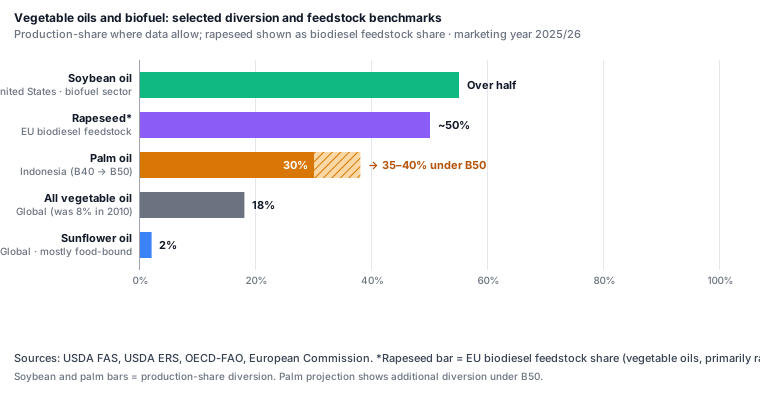
March 2026 wholesale benchmarks ran at $1,103 per tonne for CPO, $1,482 for soybean oil, and $1,739 for sunflower oil [14][15]. CPO is up roughly 22% from its May 2025 trough of $908. Soybean oil has been firm because US renewable diesel demand absorbed the 2025 crush expansion almost on impact. Sunflower oil has been the standout, rising about 19% since mid-2025 on supply-side disruption out of the Black Sea.
The mechanical effect of more biodiesel mandates, at constant supply, is straightforward. Oils are substitutes in cooking and in industrial use. If you take 5 MMT of palm oil out of the food market to put it in diesel tanks, food buyers substitute toward soybean, sunflower, and rapeseed. Soybean and rapeseed are themselves already heavily committed to biofuel demand, so they can absorb very little new food demand without pulling their own retail prices up. Within twelve to eighteen months, the four major oil prices move close to in tandem on the upside. The food market is the residual claimant.
Indonesia’s logic, on its own terms
Indonesia’s stated rationale for B40, and now B50, has three coherent pieces.
The first is energy security. Indonesia’s diesel pool is on the order of 40 billion litres a year. The 2025 ESDM allocation for B40 was 15.6 billion litres of biodiesel, implying that the rest of the pool, around 24 billion litres, is fossil gasoil [3]. B50 would lift the biodiesel share to roughly 20 billion litres. Converted at 159 litres per barrel, B40 displaces around 275,000 barrels per day of fossil gasoil. B50 displaces around 345,000. Indonesia’s net imports of crude plus refined products run at 600,000 to 700,000 barrels per day, of which gasoil specifically is 200,000 to 300,000 [3][5]. On those numbers, B50 plausibly displaces between a third and a half of total refined-product imports, and in good months close to the entire gasoil component. That is real, and it is a real fiscal benefit at the current-account level.
The second is a price floor for palm producers. Indonesian palm output has grown faster than world demand for two decades. Without the biodiesel mandate, the structural pressure on CPO would be downward, particularly as European demand has been squeezed by EU sustainability rules and the EU Deforestation Regulation (EUDR). The mandate sets a floor by guaranteeing internal absorption. GAPKI, the Indonesian palm oil association, has been explicit that without B40, planters in South Sumatra and Central Kalimantan would face a serious revenue squeeze [17]. The mandate is, in part, agricultural support policy delivered through the energy ministry.
The third is fiscal optics. Indonesia’s biodiesel program is financed by the Palm Oil Plantation Fund Management Agency (BPDPKS), which collects export levies on crude palm oil and processed palm products [4]. When the export levy is high enough, biodiesel subsidies can be paid out without burdening the general budget. The political appeal of a self-financing energy program is large in any country, and it is particularly large in Indonesia, where fuel subsidies have a long and politically expensive history.
There is a corollary to the fiscal optics worth naming, because it sets up the rest of the brief. BPDPKS collects the export levy at the Indonesian customs gate. In a market where Indonesia is the marginal supplier and palm prices are set globally, the levy is partly passed through to foreign buyers in the form of higher import prices. Palm demand at the global level is reasonably inelastic in the short run, so foreign buyers absorb a substantial share. That makes the BPDPKS-funded biodiesel program a partial cross-subsidy from Indian, European, Pakistani, and Bangladeshi food consumers to Indonesian fuel users. This is not unique to Indonesia. The EU rapeseed mandate has a similar effect on Eastern European canola buyers. US renewable diesel has a similar effect on Latin American soybean oil importers. What is unusual about the Indonesian case is the size of the diversion, the speed of the policy ramp, and the fact that Indonesia is the swing supplier for the world’s largest palm import market.
None of these rationales is dishonest. Each is the kind of argument any sane finance minister or energy minister of a fuel-importing country with a large domestic oilseed industry would make. The point of this brief is not to dispute the logic. The point is to follow the supply through, because the supply does not stay in the energy ledger.
The India demand baseline, 2025 onward
Before the 2026 shocks, the structural demand environment had already reset.
In May 2025, India’s Central Board of Indirect Taxes and Customs issued Notification 31/2025-Customs, cutting the basic customs duty on crude edible oils (palm, soybean, sunflower) from 20% to 10%. The social welfare surcharge was cut from 2.5% to 1.5%. Total duty on crude palm dropped to around 16.5%, while refined palm oil duty was held at 35.75% [23]. The structure tells you the intent. A wide gap between crude and refined duties protects domestic refiners while letting more raw feedstock in to suppress retail cooking oil inflation. The differential widened to 19.25 percentage points.
The effect was immediate. Indian palm oil imports in the June to September window after the policy revision rose 27% year-on-year to 3.4 million tonnes [23]. India is the world’s largest palm oil importer. That structural pull continues into 2026.
For the food side of the world, the May 2025 reset is the demand baseline the 2026 shocks are landing into. India’s policy choice was not a subsidy for Indonesian planters. It was a reallocation of Indian fiscal headroom from import-duty revenue to retail cooking oil affordability. The unintended consequence is that it is pulling more palm out of the export pool at exactly the moment that pool is shrinking from the supply side, and at the same time Indonesia tightens domestic absorption via B50.
What changed when Brent went to $100
The economic case for biodiesel mandates is highly sensitive to the crude oil price. An earlier draft of this analysis, written when Brent was in the $85 to $95 range, worked through the cost premium of CPO biodiesel against fossil gasoil and concluded it was 60 to 90% above the alternative, requiring an export-levy subsidy to bridge. That math is no longer current.
As of 26 May 2026, Brent settled near $100 per barrel after a month spent between $98 and $116 on renewed Middle East risk and a fragile US-Iran negotiating framework over the Strait of Hormuz [20]. The political details are volatile and not central to this brief. What matters for vegetable oils is the price level.
At $100 Brent, Asian gasoil lands at the blender’s gate at roughly $850 to $950 per tonne, up from $650 to $750 at the $85 to $95 Brent range. CPO biodiesel, at the current Rotterdam CPO benchmark of $1,103 per tonne plus around $100 to $150 per tonne of processing, costs roughly $1,200 to $1,250 to deliver. The premium is now $250 to $400 per tonne, or 25 to 45% above the fossil alternative. At $115 Brent, the premium narrows to 10 to 25%. At the $140-plus Brent that a Hormuz closure would imply, biodiesel is at parity or cheaper [8][20].
This changes one of the brief’s earlier arguments. At low crude, the BPDPKS export levy is a real cross-subsidy from foreign palm buyers to Indonesian fuel users. At high crude, the subsidy shrinks. At persistently high crude it can vanish. The fiscal optics of the mandate look very good in May 2026, and that is part of why the B50 timeline has firmed rather than slipped this quarter.
What does not change is the supply diversion. The fact that biodiesel is now economically competitive does not return the palm oil to the food market. The fiscal arithmetic shifts; the supply balance does not. That distinction matters for Indonesia’s treasury. It does not matter for the cooking oil aisle in Mumbai, Lagos, or Rotterdam.
The El Niño warning on Indonesian palm
Layer the macro shift onto a worse-than-expected supply outlook.
In April 2026, GAPKI projected Indonesian 2026 CPO output could fall by up to 2 million tonnes against 2025 levels [21]. The driver is a longer and more severe dry season tied to a strong El Niño event, layered on a 30% rise in fertiliser prices since the escalation of the Middle East conflict. Smallholder farmers, who account for 37% of Indonesia’s planted area, are reportedly delaying or skipping fertiliser application [21]. USDA forecasts a rebound to 48 MMT in 2026/27 as the 2021 to 2024 plantings reach maturity [22], so the drag is cyclical rather than structural. That is cold comfort for the next twelve months.
The supply downgrade interacts with the mandate. B40 absorbs around 14 MMT of palm-equivalent. Domestic food and industrial use absorbs another 8 to 10. At 47 MMT of production, exports clear at around 25 MMT, with comfortable headroom for the tighter food-vs-fuel year. At 45 MMT, exports clear at 23 MMT, and the marginal tonne becomes a serious political choice. B50 on top of an El Niño production hit is the configuration that most cleanly tests where the cooking oil ceiling sits.
Malaysia steps up to B15
Malaysia is the second-largest palm producer (around 19 MMT) and the country whose mandate has lagged Indonesia’s for years. That changes on 1 June 2026.
On 4 May 2026, Deputy Prime Minister Ahmad Zahid Hamidi announced that the B15 biodiesel mandate would begin phased nationwide rollout from 1 June 2026, with an interim B12 blend ramping toward the full B15 specification [11]. Nineteen licensed plants are positioned to supply. The Ministry of Plantation and Commodities has framed B15 as a stepping stone toward B20 within two to three years, with B50 mentioned as a longer-horizon ambition. Technical consultations with petroleum companies on supply-chain logistics at blending depots were completed in mid-May [11].
The implied additional palm-oil draw from B15 is in the low single-digit MMT range, depending on actual blend penetration and Malaysian diesel demand growth, on top of the roughly 1.5 MMT B10 was already absorbing. That is meaningful for a country that exports the bulk of its output. The Ministry has insisted the B15 rollout will not constrain export availability [11]. Whether that holds in practice depends on yield, refinery throughput, and CPO price. In a $1,100-plus CPO environment, the mandate substitutes for fossil gasoil at narrowing premia. In a price spike, the export-vs-domestic trade-off tightens.
Malaysia’s move matters for two reasons. First, it confirms that the regional direction is up, not sideways. Indonesia is not the only ASEAN country tightening domestic palm absorption. Second, Malaysia’s mandate is less politically encumbered than Indonesia’s because the country has a smaller domestic palm cooking-oil price-control regime and a thinner subsidy fiscal footprint. Malaysia can implement faster, with fewer trip-wires, than Indonesia. The two markets are now moving in step, with Malaysia closing some of the lag.
Thailand’s biofuel conflict, in real time
Thailand is the clearest case in the region of the food-vs-fuel tension being managed rather than resolved.
On 21 November 2024, the Thai Ministry of Energy reduced the biodiesel content in the standard B7 road-diesel pump from 7% to 5% [12]. The reduction was approved by the Energy Policy and Planning Office (EPPO) after retail biodiesel prices crossed 48 baht per litre, driven by rising CPO costs. The policy is officially temporary. The label on the pump still reads B7. The actual content is B5.
What looks like a retreat is, on closer inspection, a more conflicted posture. The Ministry of Energy has continued to promote higher-blend biodiesel through price subsidies rather than through the mandate. B20 retails approximately 5 baht per litre below B7 [12]. The Fuel Fund cut refinery-gate prices for B7 and B20 by 2 baht per litre to support adoption [12]. The cabinet extended the biofuel subsidy framework through 24 September 2026, signalling that the price-incentive structure is intended to keep biodiesel uptake elevated even as the mandatory blend was eased. The Oil Fuel Fund finances the subsidy and ran a deficit around THB 10 billion as of March 2026, with reporting describing daily losses of roughly 1 billion baht in periods of crude price spikes [12]. The fund balance is the visible fiscal expression of trying to hold retail diesel prices and biofuel incentives together at the same time.
In parallel, Thailand’s new biofuel roadmap names B7 and E20 (20% ethanol gasoline) as the two primary road fuels going forward, phasing out Gasohol 91, Gasohol 95, and E85 by 2027 [12]. A separate Sustainable Aviation Fuel mandate is set at 1% in 2026, scaling to 8% by 2036, using surplus ethanol from the road-fuel restructuring. The country has, in other words, simultaneously eased the mandatory palm content of the default diesel blend while subsidising higher palm-content options, while committing to ethanol expansion and aviation biofuels.
The Thai case demonstrates the brief’s central argument in real time. When palm prices were soft, Thailand ran B7 comfortably. When palm prices rose, the food-vs-fuel cost of the mandate became politically visible. The Ministry of Energy did not abandon the biofuel agenda. It moved the implementation from mandate to price subsidy. The Oil Fuel Fund pays the cost of keeping higher-blend uptake alive, and the deficit on the fund is the measurable expression of the policy conflict. Thailand has a smaller domestic palm base than Indonesia (3.5 MMT versus 47), so the tension is more acute, the levers are different, but the underlying squeeze is the same.
Ukrainian sunflower exports become attack-sensitive
The smallest of the four major oils on the chart is the one the brief has had to keep updating. Ukraine remains the world’s largest sunflower oil exporter, holding about 33% of global trade despite the war [24]. Through 2025 and into 2026, sustained Russian missile strikes on Ukrainian Black Sea port infrastructure (Allseeds tanks at Pivdenny in December 2025, the Kernel oil refinery at Chornomorsk in the same period) have repeatedly knocked sunflower oil export volumes offline [24]. Rail cannot substitute at scale. Russian sunflower oil has been taking Ukrainian market share in India, Turkey, and Italy.
The picture is intermittent rather than collapsed. Export volumes can recover between attack windows, and Ukrainian crushing capacity has been resilient under repeated strikes. But the chart’s 19% sunflower price rise since mid-2025 reflects an export profile that is increasingly attack-sensitive rather than reliably flowing [24]. The diversion arithmetic section above noted Black Sea supply-side disruption in passing. The full picture is a sunflower trade that has become a higher-volatility component of the global vegetable oil balance, narrowing the substitute pool for buyers displaced by tighter palm.
Where the other regional mandates sit
The 2025 to 2026 period has been a natural experiment in what these mandates do when palm prices rise. Outside Thailand and Malaysia, the picture is more static.
The Philippines has had a B3 coconut-methyl-ester mandate since 2015. Plans to raise it to B4 in 2025 and B5 in 2026 were suspended in July 2025 [13]. The trigger was a rolling spike in coconut oil prices, which hit roughly USD 2,900 per tonne in early 2025. Coconut is a small, thin market relative to palm, and the country uses CME rather than palm-derived biodiesel for political reasons related to the coconut farmers’ lobby. The thinness of the coconut market is the reason the Philippine mandate keeps stalling at B3.
Vietnam has no biodiesel mandate. The country is a net palm importer of about 1.1 to 1.3 MMT, mostly for food. Its biofuel policy focuses on ethanol blending, which is a separate market.
China has no national biodiesel mandate either. Regional pilots have never pushed the national blend above 0.3%. Beijing’s biofuel focus has shifted to sustainable aviation fuel and marine biofuels, which use waste oils rather than virgin vegetable oils, and therefore do not compete directly with food (see the biofuel feedstock imports page for the EU UCO import dataset).
The regional pattern is pro-cyclical. Mandates expand when palm and competing oil prices are soft. They stall, retreat, or shift to subsidy form when prices rise. As a stabilising tool for either food prices or diesel imports, they work in the wrong direction. The cleanest expression of the regional policy divergence is the basis between Indonesian, Malaysian, Thai, and Philippine biofuel feedstock prices.
The 2022 precedent and the political ceiling
Anyone modelling Indonesian biodiesel ambition needs to keep April 2022 in mind. That month, in response to a domestic cooking oil shortage that had built up over six months of rising global CPO prices, Indonesia banned palm oil exports entirely [9]. The ban lasted about three weeks before it was lifted in stages, and the cooking oil aisle situation eased over the following two months. The economic damage to Indonesian palm exporters was substantial. The political damage to the Jokowi administration was contained but real.
The 2022 episode is the empirical anchor for what the political ceiling on B50 looks like. If domestic palm cooking oil prices rise far enough, the government will not stand by and watch consumers struggle to fry tempeh. The levers available, in rough order of escalation, are: increased MinyaKita subsidised distribution; export tax increases via the BPDPKS levy schedule; informal export pressure on the major palm refiners (Wilmar, Musim Mas, Permata Hijau, Apical); and at the extreme, an export ban or a domestic market obligation (DMO) requiring refiners to supply a fixed share of output domestically.
DMOs are the policy lever most relevant to B50. Indonesia operated a DMO of various designs from 2022 through 2024. The DMO is a quieter form of the export ban and has the same effect: it lowers the marginal incentive to produce for export, which over time reduces global supply. In a B50 world, where domestic palm demand from biodiesel is already 17 MMT and food demand is another 8 to 10 MMT, the DMO becomes the default crisis tool. The government has signalled in early 2026 that it does not want to use it. The policy is on the shelf.
The political ceiling on B50 is the price at which cooking oil at Alfamart triggers the DMO. The 2022 episode suggests a threshold in the high IDR 20,000s per litre. Current Alfamart shelf price for a 1L Sania pouch is IDR 21,600 [as observed in the monitor data]. There is room above current prices, but not a great deal. An El Niño palm crop with B50 ramping on top of $100 crude is the configuration that most directly tests that ceiling.
Three scenarios for 2027–2030
The framing below is this analyst’s reading of the alignment, not a quantitative forecast.
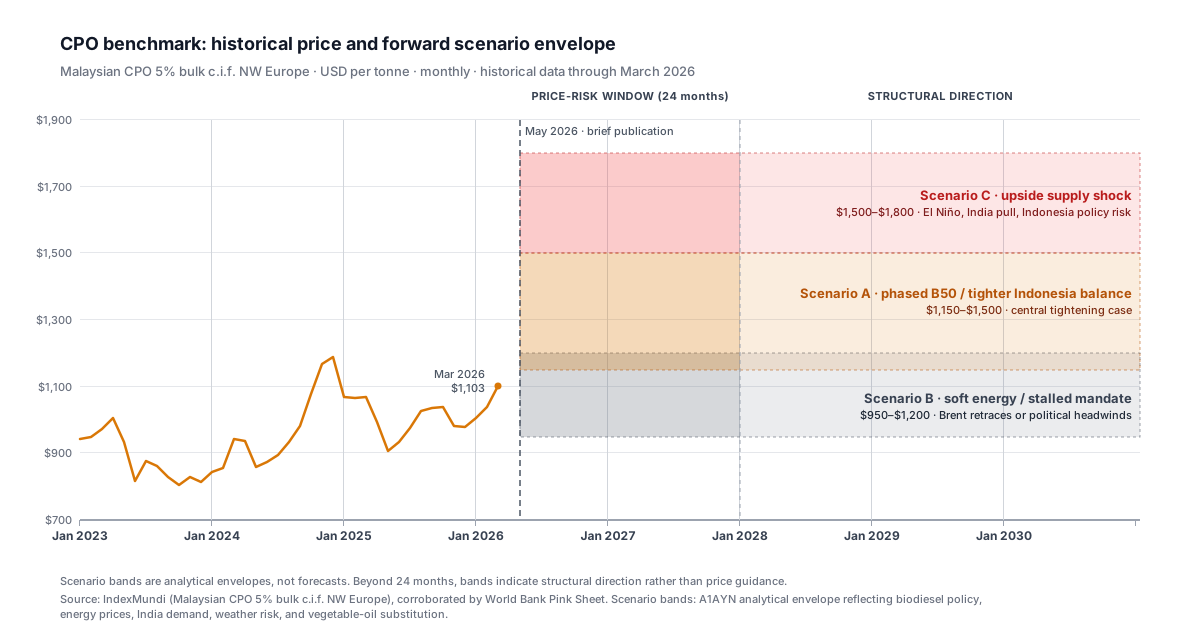
Scenario A: phased B50 lands, with regional drift up. Indonesia rolls B50 nationally in Q4 2026 or Q1 2027, with phased implementation through 2028. Malaysia delivers B15 from June 2026 and progresses toward B20 by 2028. Thailand restores B7 as the default once palm prices stabilise. Philippines maintains the suspension on B4. Global biofuel share of vegetable oil rises from 18% to 22 to 24% by 2030. CPO benchmark settles in a USD 1,150 to 1,500 per tonne range, with episodic spikes to USD 1,500 to 1,700 when Indonesian crops disappoint. Cooking oil retail prices in ASEAN are 20 to 30% higher in 2030 than in 2025 in nominal local currency. Central tightening case under current Indonesian fiscal and political alignment, plus a high crude oil environment.
Scenario B: stalled B50, refinery-capacity ceiling binding. B50 keeps slipping. Refinery capacity, blender warranty issues on older engines, and the cooking oil price ceiling combine to hold the effective national blend at B40 to B45 through 2028. Indonesia formally retains the B50 target but never operationalises it at scale. Malaysia delivers B15 but does not advance to B20 in this window. Thailand keeps the B7 label on B5 content and continues to fund higher-blend uptake through the Oil Fuel Fund despite the deficit. The food-vs-fuel competition stabilises rather than intensifies. Global biofuel share of vegetable oil rises to 19 to 20% by 2030. CPO benchmark trades in a USD 950 to 1,200 range. Cooking oil retail prices in ASEAN are flat to modestly up in real terms. Plausible if Brent retraces meaningfully and the urgency behind B50 fades, or if a 2027 election cycle elevates cooking-oil inflation as a campaign issue.
Scenario C: the unwind. The El Niño production hit lands harder than GAPKI’s 2 MMT projection. India sustains the duty-cut driven import pull. Sunflower remains supply-constrained on the Ukraine side. ASEAN cooking oil prices push past the 2022 political ceiling in late 2026 or 2027. Indonesia activates the DMO. Thailand keeps the B5 default. Philippines does not reintroduce B4. Malaysia pauses or slows its phased B20 progression. The global vegetable oil price spikes briefly, the diversion share retraces from 18% toward 16%, and the policy direction across the region turns net cautious for two to three years. CPO benchmark spikes to USD 1,500 to 1,800 before retracing. More likely than it was three months ago. The combination of El Niño, India duty cut, and high crude is the kind of triple stack that tests the political ceiling rather than slowly approaches it.
In all three scenarios, the long-run direction is up. None involves a wholesale repeal of B40 or its regional equivalents. The variance is in the speed and slope of the ramp, in whether the food-side ceiling holds, and in whether 2026 turns out to be the year that tests it.
Implications
For Indian, European, Pakistani, and Bangladeshi buyers of palm and palm derivatives, the read is structural rather than cyclical. Indonesian export volumes are now a residual of domestic biodiesel demand minus an El Niño-shrunk production base, with Malaysia’s new B15 absorption layered on top. As B50 lands, that residual is smaller and more volatile. Sourcing decisions need to assume CPO availability in the USD 1,150 to 1,500 per tonne range as the working baseline, with episodic spikes to 1,700-plus when Indonesian policy pulls volume domestically. The freight cost channel is a second-order amplifier: with Red Sea routing still constrained and most Indonesian palm shipments to Europe taking the Cape route, freight adds USD 30 to 60 per tonne on top of the levy and price effects (see the maritime page for live chokepoint data).
For ASEAN-focused commodity buyers, the asymmetry across the region is the live trade. Thailand and the Philippines have demonstrated that their mandates yield under price pressure, but Thailand’s response has been a shift to subsidy rather than abandonment. Indonesia and Malaysia have demonstrated that their mandates do not yield, at least not quickly. The basis between Thai and Indonesian palm prices, and between Philippine coconut and Indonesian palm, is the cleanest expression of the regional policy divergence.
For European policy audiences, the relevant point is that EU dependence on Asian biofuel feedstocks, used cooking oil in particular, is now exposed to ASEAN biodiesel policy in a way that the EU UCO import dataset on the biofuels page makes visible. As ASEAN diverts more virgin oil into its own diesel tanks, the supply of UCO available for EU export thickens in some scenarios and thins in others, depending on whether ASEAN consumes more vegetable oil overall or simply reallocates it. The UCO trade has its own dynamics, including EU import dependency, ASEAN export volatility, and the open question of traceability under the EU Renewable Energy Directive’s fraud screening rules. A dedicated brief on UCO is forthcoming.
For Indonesian and Malaysian planters, the floor is real and the upside is real. The risk that does not get priced is the policy ceiling on the upside. The 2022 episode was a warning that the cooking oil aisle is a hard binding constraint, and that constraint reasserts itself periodically. The current configuration of El Niño, Indonesian B50 ramp, Malaysian B15 rollout, and high crude is the most direct test of it since 2022.
For the food side of the global market, which is the residual claimant in every scenario, the implication is the most direct. Vegetable oil’s pricing anchor has shifted from food-demand fundamentals to energy-substitution math. Since 2010, that has shaped the price of every extra tonne brought to market. After B50 and Malaysia’s B15, with the supply downgrade and the Indian import pull running concurrently, it shapes the price of the whole stack. The food side does not get a vote in this, and the food side does not get a subsidy. The food side pays.
References
[1] USDA Foreign Agricultural Service, Oilseeds: World Markets and Trade (May 2026 circular). Monthly world supply, demand, and trade balance for major oilseeds and vegetable oils. https://www.fas.usda.gov/data/oilseeds-world-markets-and-trade
[2] Nikkei Asia, “Palm oil prices to spike in 2026 as Indonesia pushes biofuel policy” (14 November 2025). Discussion at the Indonesia Palm Oil Conference in Bali on the bullish price impact of B45/B50 mandate progression. https://asia.nikkei.com/business/markets/commodities/palm-oil-prices-to-spike-in-2026-as-indonesia-pushes-b50-experts-warn
[3] Government of Indonesia, Ministry of Energy and Mineral Resources (ESDM), Ministerial Decree No. 341.K/EK.01/MEM.E/2024. Mandatory use of biodiesel as a diesel-fuel blend at 40 percent, effective 1 January 2025 with phased implementation through the first quarter. ESDM communiqué on B50 field-testing and second-half-2026 implementation target. https://www.esdm.go.id/id/media-center/arsip-berita/wujudkan-ketahanan-energi-dan-kurangi-impor-menteri-esdm-mandatori-b40-berlaku-1-januari-2025
[4] BPDPKS (Badan Pengelola Dana Perkebunan Kelapa Sawit). Indonesia’s Palm Oil Plantation Fund Management Agency: export levy schedule, biodiesel subsidy disbursement framework. https://www.bpdp.or.id/
[5] USDA FAS GAIN Report, Indonesia Biofuels Annual 2025. Country-level analysis of Indonesian biodiesel program, B40 implementation, and B50 transition planning. https://apps.fas.usda.gov/newgainapi/api/Report/DownloadReportByFileName?fileName=Biofuels+Annual_Jakarta_Indonesia_ID2025-0029.pdf
[6] OECD-FAO Agricultural Outlook 2025–2034. Vegetable oil supply, demand, and biofuel diversion projections through 2034. https://www.oecd-ilibrary.org
[7] World Bank, Commodity Markets Outlook (April 2026). https://www.worldbank.org/en/research/commodity-markets
[8] IEA, Oil Market Report (May 2026) and Renewables 2025. Gasoil and biofuel demand commentary. https://www.iea.org
[9] Indonesia’s April–May 2022 palm oil export ban. Al Jazeera, “Indonesia widens export ban to include crude palm oil” (27 April 2022), https://www.aljazeera.com/economy/2022/4/27/indonesia-widens-export-ban-to-include-crude-palm-oil. BenarNews, “Jokowi: Indonesia to end ban on palm oil exports” (19 May 2022), https://www.benarnews.org/english/news/indonesian/palm-oil-exports-05192022140014.html. Norton Rose Fulbright legal note, https://www.nortonrosefulbright.com/en/knowledge/publications/0297596e/indonesian-government-ban-palm-oil-export
[10] Statistics Indonesia (BPS), monthly Consumer Price Index release. Cooking oil subcomponent of food and beverages inflation. https://www.bps.go.id
[11] Malaysia B15 announcement (May 2026). Paultan, “B15 biodiesel to be rolled out June 1, 2026 — Zahid” (4 May 2026), https://paultan.org/2026/05/04/b15-biodiesel-to-be-rolled-out-june-1-2026-zahid/. The Star, “B15 implementation in peninsular Malaysia will not affect palm oil exports” (25 May 2026), https://www.thestar.com.my/business/business-news/2026/05/25/b15-implementation-in-peninsular-malaysia-will-not-affect-palm-oil-exports. Malay Mail, https://www.malaymail.com/news/malaysia/2026/05/04/malaysia-to-roll-out-b15-biodiesel-from-june-1-says-zahid/218670. Malaysian Palm Oil Board (MPOB) and Ministry of Plantation and Commodities, blending mandate schedule and refinery-capacity policy, https://www.mpob.gov.my
[12] Thailand Ministry of Energy / Energy Policy and Planning Office (EPPO). B7 to B5 reduction effective 21 November 2024: Nation Thailand, “Thailand cuts palm oil content in biodiesel to curb rising costs” (November 2024), https://www.nationthailand.com/news/policy/40043103. B20 and B7 refinery price subsidies: Thai PBS World, “Bt2 refinery price cut for B7, B20 — Energy minister,” https://world.thaipbs.or.th/detail/60931. Biofuel roadmap (B7 + E20 as primary road fuels, Gasohol 91/95/E85 phaseout by 2027, SAF 1% in 2026 to 8% by 2036): Nation Thailand, “Thailand’s new biofuel roadmap: SAF mandate, E20/B7 focus,” https://www.nationthailand.com/sustaination/40057053. Oil Fuel Fund deficit (March 2026, around THB 10 billion, with daily losses near 1 billion baht during crude price spikes): Nation Thailand, “Government plans diesel rise as oil fund hits THB10 billion deficit,” https://www.nationthailand.com/blogs/news/policy/40063654; Nation Thailand, “Oil Fuel Fund caps diesel support at 18.31 baht/litre as fund balance sinks to 12.6bn baht deficit,” https://www.nationthailand.com/news/general/40063847; Bloomberg, “Thailand’s Oil Fund Burns $32 Million A Day to Cap Diesel Prices” (11 March 2026), https://www.bloomberg.com/news/articles/2026-03-11/thailand-s-oil-fund-burns-32-million-a-day-to-cap-diesel-prices. Industry outlook context: Krungsri Research, “Industry Outlook 2025-2027: Biodiesel,” https://www.krungsri.com/en/research/industry/industry-outlook/energy-utilities/biodiesel/io/io-biodiesel-2025
[13] Department of Energy, Philippines. July 2025 suspension of B4 and B5 mandate progression; B3 coconut-methyl-ester baseline retained. Reported via USDA FAS Manila and industry coverage.
[14] FRED PSUNOUSDM, IMF Primary Commodity Prices (Sunflower Oil). Source for the sunflower benchmark in the vegetable oil monitor. https://fred.stlouisfed.org/series/PSUNOUSDM
[15] IndexMundi, Palm Oil (Malaysia), 5% bulk, c.i.f. N.W. Europe. Source for the CPO benchmark in the monitor. https://www.indexmundi.com/commodities/?commodity=palm-oil
[16] USDA Economic Research Service, Oil Crops Outlook (April 2026). US soybean oil supply, demand, and renewable diesel diversion. https://www.ers.usda.gov/publications/pub-details/?pubid=110000
[17] GAPKI (Gabungan Pengusaha Kelapa Sawit Indonesia), Indonesian Palm Oil Association. Annual production and trade statistics, planter commentary on the biodiesel mandate. https://gapki.id/
[18] EU Renewable Energy Directive (RED II / RED III). Feedstock caps for food-based biofuels, UCO-based biofuel incentives, fraud-screening rules. https://eur-lex.europa.eu/legal-content/EN/TXT/?uri=CELEX:32023L2413
[19] A1AYN, Vegetable Oil and Biofuel Blending Monitor. Weekly tracker covering wholesale benchmarks, retail cooking oil prices, blending mandates, and biofuel diversion across ASEAN+. https://a1ayn.com/data/vegetable-oil-monitor/
[20] Brent crude oil price reference, May 2026. Trading Economics Brent series, https://tradingeconomics.com/commodity/brent-crude-oil. Reuters daily energy reporting on Brent levels and Hormuz-related risk premia.
[21] GAPKI on 2026 El Niño production risk. Industry briefing, April 2026, cited via Bernama / The Star, “Indonesia 2026 crude palm oil output to fall due to El Niño, high fertiliser prices, association says,” https://www.thestar.com.my/business/business-news/2026/04/29/indonesia-2026-crude-palm-oil-output-to-fall-due-to-el-nino-high-fertiliser-prices-association-says
[22] USDA FAS Indonesia, Oilseeds and Products Annual. 2026/27 production rebound forecast to 48 MMT. https://apps.fas.usda.gov/newgainapi/api/Report/DownloadReportByFileName?fileName=Oilseeds+and+Products+Annual_Jakarta_Indonesia_ID2025-0015.pdf
[23] Government of India, CBIC Notification 31/2025-Customs dated 30 May 2025. Crude palm, soybean, and sunflower oil basic customs duty cut from 20% to 10%; social welfare surcharge cut from 2.5% to 1.5%; refined palm oil duty held at 35.75%. Differential widened to 19.25 points. Reported impact of 27% YoY palm imports in June–September 2025. Department of Food and Public Distribution, https://dfpd.gov.in/import-export/en. Commentary at Angel One, https://www.angelone.in/news/market-updates/government-reduces-import-duty-on-crude-edible-oils-to-10, and A2Z Taxcorp, https://a2ztaxcorp.net/cbic-reduces-import-duty-on-edible-oils-and-extends-exemption-for-yellow-peas/
[24] Ukraine sunflower oil export disruption, 2025–2026. UkrAgroConsult, “Sunflower oil exports from Ukraine through ports have almost stopped after a series of attacks,” https://ukragroconsult.com/en/news/sunflower-oil-exports-from-ukraine-through-ports-have-almost-stopped-after-a-series-of-attacks/. “Ukraine holds 33% of global sunflower oil exports despite aggressive Russian expansion,” https://ukragroconsult.com/en/news/ukraine-holds-33-of-global-sunflower-oil-exports-despite-aggressive-russian-expansion/. “Ukrainian crushing industry recovers after massive attacks,” https://ukragroconsult.com/en/news/ukrainian-crushing-industry-recovers-after-strikes/
Wholesale benchmark prices and exchange rates in this brief refresh weekly through the monitor page. Where a number is described as “current,” it refers to the most recent observation as of 26 May 2026. The Brent and Indonesian production figures are May 2026 spot conditions and will move. Scenario assignments are this analyst’s reading of policy and market alignment, not a quantitative forecast.