CBAM is the EU regulation we get asked about most often by exporters into Europe, and the reason is structural. It’s the regulation where compliance has a clear euro price. A procurement team that ignores forced-labour due diligence faces a risk that may or may not bite. A procurement team importing cement, iron and steel, aluminium, fertilisers, hydrogen or electricity into the EU under CBAM pays a bill that rises every year until 2034.
At the time of writing, 12 May 2026, the EUA front-month settled at €75.64 per tonne CO₂e [16]. That price refreshes weekly via the CBAM page, and the cost figures in this brief use it. The political analysis draws on the European Parliament’s published composition [4][5] and on policy positions taken in the chamber and Council during the first year of the 2024–2029 mandate. The scenarios at the end are this analyst’s assessment, not a forecast.
The cost as of 12 May 2026
The definitive phase began on 1 January 2026. In year one, EU ETS free allocation for CBAM sectors drops by 2.5%, and importers must surrender certificates covering that 2.5% of embedded emissions. The full phase-out trajectory is set in the EU ETS Directive as amended in 2023 [3] and in CBAM Regulation Article 36(b) [1]:
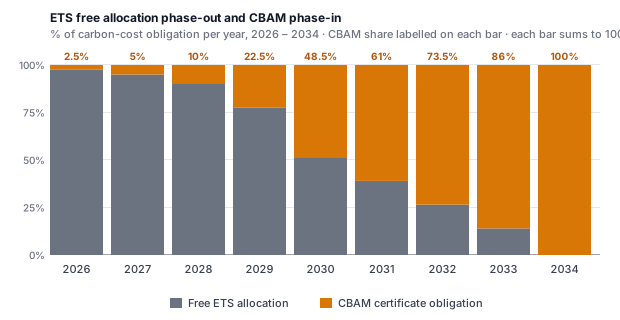
The EUA front-month future settled at €75.64 per tonne CO₂e at the last weekly refresh on 12 May 2026, within a 52-week range of €62.29 to €91.94 [16]. At that price:
| Year | CBAM coverage | Implied cost per tCO₂e |
|---|---|---|
| 2026 | 2.5% | €1.89 |
| 2030 | 48.5% | €36.69 |
| 2034 | 100% | €75.64 |
The 2030 figure is the commercially decisive one. Translated into delivered-product costs using IEA Iron and Steel Technology Roadmap and IEEFA published intensity ranges [8][10]:
- Chinese hot-rolled coil. Roughly 2.0 to 2.3 tCO₂e per tonne of crude steel (BF–BOF route, coal-heavy electricity). At 2030 CBAM coverage, that translates into about €73 to €84 per tonne of steel.
- Indian flat steel. Roughly 2.4 to 2.6 tCO₂e per tonne [10]. About €88 to €95 per tonne at 2030 coverage.
- Turkish cement. Roughly 0.80 to 0.90 tCO₂e per tonne (high clinker-to-cement ratio, dry kiln) [9]. About €29 to €33 per tonne of cement at 2030 coverage.
These costs don’t kill deals on their own. They do shift the margin enough to matter. Live chart, current EUA price, and full year-by-year cost schedule at /data/compliance/cbam/.
The 2024 European Parliament: composition and CBAM voting record
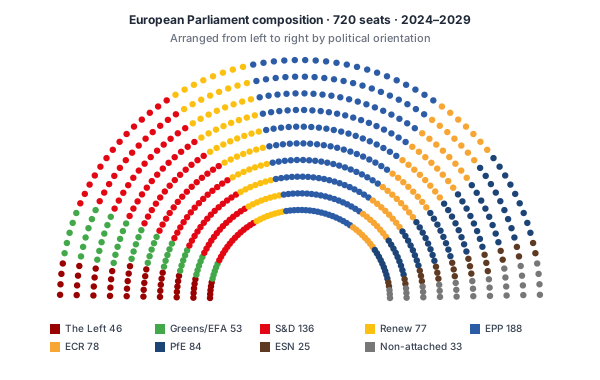
The June 2024 European Parliament elections shifted the chamber to the right. Final group composition of the 720-seat Parliament after the new groups formed in July 2024 [4][5]:
| Group | Seats | Position on CBAM |
|---|---|---|
| EPP (European People’s Party) | 188 | Backed CBAM adoption in 2023. Supports the definitive phase. Increasingly attentive to administrative complexity and to competitiveness concerns from German and Italian industrial federations. |
| S&D (Socialists and Democrats) | 136 | Consistently CBAM’s strongest mainstream defender. Supports scope expansion. |
| PfE (Patriots for Europe) | 84 | New group formed in July 2024 (Rassemblement National, Lega, Fidesz, FPÖ, PVV). Generally hostile, particularly to indirect-emissions inclusion. |
| ECR (European Conservatives and Reformists) | 78 | Split. Fratelli d’Italia (≈24 MEPs) pragmatic in Council and Parliament. PiS (≈20 MEPs) more sceptical. |
| Renew Europe | 77 | Down from 102 pre-election. Supportive but more vocal on competitiveness than in the previous mandate. |
| Greens/EFA | 53 | Strongest advocates of CBAM scope expansion, faster phase-out, and indirect-emissions inclusion. |
| The Left | 46 | Divided. Some criticise CBAM as insufficient on climate, others as protectionist. |
| ESN (Europe of Sovereign Nations) | 25 | New group formed in July 2024 (AfD-led). Opposed. |
| Non-attached | 33 | Mixed positions. |
The pro-CBAM defensive majority (S&D plus Renew plus Greens plus most of EPP, with The Left often joining defensively) is intact, but thinner than in 2019–2024 and more dependent on EPP discipline. The offensive coalition for scope expansion is materially weaker than the coalition for defending the existing regulation.
The likelihood arithmetic
A back-of-envelope vote count for three CBAM-relevant scenarios under current alignment. The threshold is 361 votes (absolute majority of 720). EPP discipline is the swing variable in every count.
| Vote scenario | Probable yes-count | Read |
|---|---|---|
| Defend current CBAM against a dilution amendment | S&D (136) + Renew (77) + Greens (53) + aligned Left (~25) + EPP majority (~140 of 188) ≈ 431 | Comfortably above threshold. EPP defection would need leadership-level breakage, which is politically expensive since CBAM is an EPP-era legislative achievement under Weber. |
| Expand scope to chemicals/polymers or indirect emissions for steel/aluminium | Same centre-left base + EPP soft yes (~100 of 188) ≈ 391 if EPP discipline holds. ~330 if 50 EPP MEPs join the competitiveness caucus. | Just above threshold, contingent on EPP. Requires Commission concessions on adjacent simplification (CSRD, CSDDD) to hold EPP discipline. |
| Dilute CBAM (sector carve-outs, slower phase-out, downstream scope narrowing) | PfE (84) + ESN (25) + ECR sceptics (~50 of 78) + EPP competitiveness caucus (~40 of 188) + NI (~15 of 33) ≈ 215 | Far below threshold. Wholesale dilution is not viable without a 50+ MEP EPP shift, which would require sustained industrial-coalition pressure coordinated across multiple Member States. |
The arithmetic explains the Commission’s calibration. Simplifying around CBAM (the Omnibus I package exempted small importers covering ~90% of importers by count but only ~1% of emissions volume [6]) is politically cheap because it does not touch the core architecture. Expanding scope is harder. Diluting the core is hardest.
Two votes in the first year of the new Parliament confirm the pattern:
- Ursula von der Leyen re-elected Commission President on 18 July 2024 with 401 votes (above the 361 minimum), backed by a coalition of EPP, S&D, Renew and Greens [4]. CBAM continuity was an implicit term of the coalition agreement.
- Commission Communication COM(2025) 81, the “Omnibus I” simplification package, proposed 26 February 2025, made significant cuts to CSRD and CSDDD scope but left CBAM’s core architecture intact [6]. The CBAM-specific change was the “occasional importer” exemption: importers of less than 50 tonnes of CBAM goods per year are exempted, removing ~90% of importers by count while covering only ~1% of emissions volume.
Where the political risk sits, 2026–2027
Three pressure points are worth watching.
1. The 2026 Article 30 scope review. CBAM Regulation Article 30 [1] requires the Commission to assess extension to organic chemicals and polymers, and to indirect emissions, by the end of the transitional phase. The Commission’s review draft is expected in late 2026. Expanding CBAM into chemicals brings CEFIC and Eurometaux directly into opposition [13]. Narrowing it disappoints the centre-left and Greens.
2. The 2026–2027 national election cluster.
| Date | Election | Significance |
|---|---|---|
| 12 April 2026 | Hungary, parliamentary | Fidesz vs. Tisza opposition. Affects PfE’s strength and Council leverage. |
| Spring 2027 | Poland, parliamentary | Tusk coalition vs. PiS rematch. Affects ECR alignment. |
| 11–25 April 2027 | France, presidential (round 1, round 2) | RN/Le Pen successor vs. centrist bloc. Decisive for the Franco-German motor of EU climate leadership. |
| Late 2027 | Czech Republic, parliamentary | ANO vs. SPOLU. Affects the Visegrád-aligned Council bloc. |
A Rassemblement National win in France would not unwind CBAM (qualified-majority voting in Council makes unilateral repeal difficult), but it would weaken EU climate leadership and embolden the dilution coalition inside the Council.
3. WTO and bilateral pushback. China, India, Brazil and the broader BRICS+ bloc have made formal objections to CBAM as a disguised trade barrier. A WTO dispute would not stop CBAM. Article XX exceptions for environmental measures are available, and CBAM is intentionally designed to fit them [7]. But a dispute would constrain scope expansion and reinforce competitiveness arguments inside the EU. Bilateral pressure points: ongoing UK ETS linkage talks, Western Balkans Energy Community pricing convergence, Turkey’s domestic ETS pilot.
Three forward scenarios for 2027–2030
The framing below is this analyst’s reading of the alignment, not a quantitative forecast.
Scenario A: phased tightening. The Commission’s 2026 review extends CBAM to organic chemicals and polymers from 2027–2028, includes indirect emissions for iron/steel and aluminium from 2028, and tightens default values. EPP accepts the extension in exchange for further simplification on adjacent regulations (CSRD, CSDDD). CBAM cost ramps as scheduled. Most likely under the current alignment between Commission and Parliament.
Scenario B: status quo with friction. Phase-out continues on schedule. Scope expansion delayed to 2030 and beyond. Indirect emissions remain reporting-only. Sector-specific transitional relief negotiated for fertilisers and downstream products. Plausible if the 2026 scope review surfaces strong industrial-coalition pushback that EPP responds to.
Scenario C: selective dilution. A combination of post-2027 national-election shifts and sustained industrial-coalition pressure narrows downstream product scope, slows the phase-out for specific sectors (for example by extending free allocations beyond 2034 for fertilisers), or creates carve-outs by origin (for example UK-linked or partnership-country preferences). Wholesale rollback is unlikely, because CBAM revenue is earmarked for the Social Climate Fund under the Multiannual Financial Framework, but pieces could erode. Less likely but not negligible. Requires a meaningful shift in EPP position triggered by Council pressure.
In all three scenarios the definitive-phase architecture is intact: importers still need authorised CBAM declarant status, still report embedded emissions, still surrender certificates. The variance is in scope, pace, and indirect-emissions coverage, not in whether CBAM exists.
CBAM and EU competitiveness
CBAM is meant to protect EU industrial competitiveness from carbon leakage. Imported goods made under weaker carbon constraints would otherwise undercut EU producers paying their ETS bill [7]. That is the intent. The actual effect on EU competitiveness is more uneven than the headline.
The protective effect works in covered sectors. CBAM covers six: cement, iron and steel, aluminium, fertilisers, hydrogen, electricity. Eurofer estimates the carbon-leakage costs CBAM is designed to recover or prevent at roughly €16 billion annually [12]. For producers in those sectors, CBAM levels the cost playing field at the EU border.
The downstream input-cost effect cuts the other way. EU manufacturers that consume CBAM-priced inputs face higher landed costs, both directly (imports) and indirectly, as EU producers pass through the carbon cost when free allocations phase out. The EU automotive sector uses roughly 150 to 200 tonnes of steel per €1 million of vehicle output [10][13]. EU machinery, construction, packaging and white-goods sectors face similar input-cost transmission. ACEA and BusinessEurope have flagged this in their CBAM submissions [13] as a competitiveness risk for EU manufacturers exporting finished goods to non-EU markets.
Exports get no equivalent mechanism. A US-based importer of EU-made cars pays no carbon-cost adjustment. EU steel exporters to Asia compete head-to-head with Chinese exporters that face no EU carbon cost in those third markets. EU producers carry their full ETS exposure outside the EU without offset. The Commission’s Article 30 review is required to assess this [1], but a CBAM-equivalent export rebate raises WTO-compatibility complications the Commission has so far avoided. Eurofer’s position is to push for an export-adjustment mechanism [12]. The Commission has not endorsed it.
Retaliation risk. China, India, Brazil and the broader BRICS+ bloc have signalled formal WTO objections and the possibility of countermeasures. A retaliation cycle would hit EU exporters of finished manufactured goods, the part of the EU economy that gets no CBAM protection.
Asymmetric scope. CBAM does not yet cover organic chemicals, polymers, glass, paper, or ceramics, all of which are carbon-intensive. Each year scope expansion is delayed, carbon leakage in the uncovered sectors continues. Each year scope is expanded, the downstream input-cost effect on EU manufacturers compounds. The 2026 Article 30 scope review [1] is precisely the venue where this trade-off becomes a vote.
CBAM is sector-specific and dynamic. Upstream EU producers in covered sectors gain. Downstream EU manufacturers face higher input costs in covered-sector intermediates. EU exporters of finished goods to third markets carry full ETS cost without rebate. The political economy of the 2026 scope review is the question of how much further to push this balance, and whether to add an export rebate that would tilt it back [11].
Implications
For EU buyers in CBAM-covered supply chains, the political uncertainty is contained:
- Plan around Scenario A as the base case. Authorised declarant registration, verifier accreditation, and installation-level emissions data infrastructure pay back in all three scenarios. The data architecture has a 12 to 18 month lead time.
- Verified installation-specific emissions data is the cost-reduction lever. Default values are set above EU averages by Commission design [2], to incentivise verified reporting. A supplier that invests in monitoring and verification reduces CBAM exposure per tonne by 20 to 40% relative to default values, depending on sector.
- The biggest commercial choices are between origins, not whether to source. A supplier in a country with a credible carbon price (UK ETS, Norway ETS-linked, Switzerland ETS-linked) is structurally protected by Article 9 offsets [1]. An origin without a comparable price is fully exposed. The sourcing-strategy variable is where, not whether.
For non-EU exporters into the EU market:
- Direct exposure scales with carbon intensity, not nationality. Two installations in the same country can face very different CBAM costs depending on their per-tonne CO₂e signature. The country-of-origin headline is less important than installation-level emissions data.
- Domestic carbon pricing is structural protection. Origin countries developing comparable carbon-pricing regimes (UK, Switzerland, Norway, and emerging schemes in Türkiye, Indonesia, Vietnam, Thailand among others) give their exporters Article 9 offset eligibility [1]. Exporters in jurisdictions without comparable pricing carry the full CBAM cost.
- Verified emissions reporting beats default values. Installation-specific verified data substitutes for the deliberately conservative defaults. Investment in monitoring, reporting and verification (MRV) infrastructure is the dominant per-tonne cost-reduction lever.
- Indirect exposure is the next-tier problem. Exporters of finished products containing CBAM materials (automotive parts, electronics, construction goods, white goods) absorb CBAM costs upstream and pass them through. The exposure is real even where direct CBAM-goods exports are small.
Waiting to see how this plays out is the most expensive position for both EU buyers and non-EU exporters. The cost trajectory is locked in primary EU law, the legal architecture is robust, and engaging intelligently with CBAM has long lead times.
References
[1] CBAM Regulation (EU) 2023/956. Carbon Border Adjustment Mechanism. EUR-Lex: https://eur-lex.europa.eu/legal-content/EN/TXT/?uri=CELEX%3A32023R0956
[2] CBAM Implementing Regulation (EU) 2023/1773. Reporting obligations for the transitional period. EUR-Lex: https://eur-lex.europa.eu/legal-content/EN/TXT/?uri=CELEX%3A32023R1773
[3] EU ETS Directive 2003/87/EC as amended by Directive (EU) 2023/959. Free-allocation phase-out trajectory. EUR-Lex: https://eur-lex.europa.eu/legal-content/EN/TXT/?uri=CELEX%3A32023L0959
[4] European Parliament, 2024 Final Election Results. europarl.europa.eu/elections-2024.
[5] European Parliament, Political group composition register, July 2024. europarl.europa.eu/meps.
[6] European Commission, Communication COM(2025) 81 final (“Omnibus I” simplification package), 26 February 2025. Includes the CBAM occasional-importer exemption at 50 tonnes per year.
[7] European Commission, CBAM Impact Assessment, SWD(2021) 643 final. Carbon-leakage analysis, WTO-compatibility framing, and sectoral effects.
[8] IEA, Iron and Steel Technology Roadmap. Sector emissions baselines and intensity reference ranges for crude steel by production route.
[9] IEA, Cement Technology Roadmap. Sector emissions baselines, clinker-to-cement ratio, and kiln-technology adjustments.
[10] IEEFA, Asian steel and cement industry carbon-intensity assessments (2023–2024). Installation-level and country-aggregate intensity estimates for Chinese, Indian, Korean and South-East Asian production.
[11] Bruegel, CBAM design, external dimension, and competitiveness papers (S. Tagliapietra, G. Wolff and others, 2023–2025).
[12] Eurofer, CBAM position papers (2023–2025). European Steel Association estimates of carbon-leakage cost recovery and the case for an export-adjustment mechanism.
[13] ACEA, BusinessEurope, Eurometaux, CEFIC, industrial coalition CBAM submissions. Downstream input-cost effects, automotive steel intensity, scope-expansion positions.
[14] CEPS, ERCST (A. Marcu), ECFR, Carbon Market Watch. Independent monitoring and analytical commentary on EU ETS and CBAM design and implementation.
[15] Ember Climate, EU ETS carbon price tracker. Daily and weekly EUA settlement reference and historical context.
[16] EUA price methodology. Front-month price scraped weekly from investing.com as a proxy for the ICE EUA Dec front-month future. Front-month settlement typically trades within a small premium of the daily EEX primary auction settlement. Refreshed via a Netlify scheduled function.
Embedded-emissions intensity figures vary materially by installation and methodology. Figures in this brief should be read as well-sourced sector midpoints, not installation-specific costings. For an installation-specific assessment, the verified emissions data filed under the CBAM Registry from 2026 onward will be the authoritative reference once published.