Thailand crossed the line into an aged society around 2022, with more than one in seven of its people over 65, at a GDP per head of roughly 7,000 US dollars [3][4]. When Japan crossed the same line in the mid-1990s it was earning something like 38,000 dollars a head; Korea, around 2018, roughly 31,000 [4]. Even China, the cautionary tale of ageing before affluence, was at about 12,000 when it aged [4]. Thailand reached the same demographic milestone at a fifth of Japan’s income and well under half of China’s. It is the first ASEAN economy through that gate, and it will not be the last.
This is the third and last brief in this series. The first mapped the demographic divergence inside ASEAN [15]; the second showed how the bill for an ageing Thailand lands on families [16]; and the brief on the region’s power opportunity [14] ended on the question this one answers. The demographic dividend that drives the demand and supplies the workers is finite. The only way to stay rich as a workforce stops growing is to lift output per worker, through automation, through AI, through capital and skills. The question is whether ASEAN can do that fast enough, and at a low enough income, to win a race its predecessors mostly ran from a position of wealth. The live demographics sit on the Regional Demographics dashboard [1][2]. The scenarios at the end are this analyst’s reading, not a forecast.
The clock is already running
The alarming part is the speed. Where France took more than a century to move from an ageing society to an aged one, and the United States around seventy years, Vietnam will do it in roughly eighteen, Thailand and Singapore in about twenty [5]. The transition that the West had generations to absorb, parts of ASEAN are getting two decades to handle.
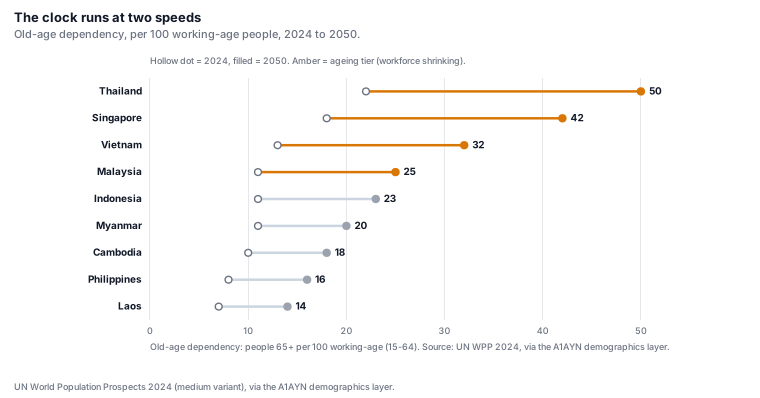
The divergence the first brief described is the thing to hold onto, because it splits the region into two different races. In the ageing tier, the working-age share has peaked and is falling: Thailand’s old-age dependency roughly doubles from 22 to 50 per hundred working-age people by 2050, Singapore’s climbs from 18 to 42, Vietnam’s from 13 to 32, on UN medium-variant numbers in the layer [1][2]. Singapore’s fertility sits at 0.95, Thailand’s at 1.20, both far below replacement [1]. In the young tier the clock barely ticks: the Philippines’ working-age share actually keeps rising to 2050, Indonesia’s old-age dependency stays near 23, and Laos, Cambodia and Myanmar are younger still [1]. Same region, two opposite problems: one half has to get productive before it shrinks, the other has to put a still-growing workforce to work.
Grow old before rich
What makes the ageing tier’s race hard is that it starts poor. The classic development sequence, the one Japan and Korea followed, is to get rich first and grow old afterwards, so that a wealthy society with deep capital and strong institutions can afford its pensioners. ASEAN is running it backwards.
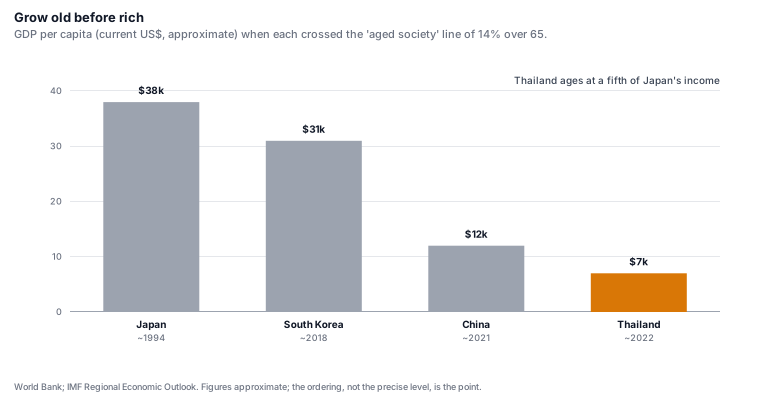
The World Bank’s verdict on the wider region is blunt: most of developing East Asia “will grow old before getting rich,” with the working-age population shrinking more than 10 percent in China, Thailand and Japan by 2040, and pension and health spending across the region set to rise many points of GDP without reform [3]. The second brief showed what that looks like from below, an old-age allowance worth a fifth of the poverty line and a family-based safety net fraying as families shrink. From above it looks like a math problem. A country that ages at 7,000 dollars a head has far less fiscal room, far less private capital, and far thinner institutions to lean on than one that ages at 38,000. The margin for error is small, and the clock does not stop.
The only way out is productivity, and that is the weak spot
If the workforce will not grow, growth has to come from each worker producing more. And productivity is exactly what ASEAN has been worst at.
Strip ASEAN’s growth into its sources and most of it is not productivity. On the Asian Productivity Organization’s accounting, total-factor-productivity growth across ASEAN ran at a moderate 0.6 percent a year over 2000 to 2023 and contributed only about 18 percent of labour-productivity growth; nearly two-thirds came from improvements in labour quality, the rest from piling on capital [6]. In East Asia, by contrast, TFP contributes about a third [6]. The region has grown by adding workers, schooling them better, and building more factories and roads, not by getting dramatically more efficient with what it has. Through 2015 to 2023, ASEAN’s TFP essentially stagnated even as investment continued [6]. And the frontier is pulling away, not closing: the United States holds a productivity-per-hour lead of more than 30 percent over even the best Asian performers, and only Singapore has narrowed it to single digits [6].
That is the textbook setup for the middle-income trap, the point where the cheap-labour, capital-deepening playbook runs out before the innovation-and-productivity playbook kicks in [7]. Dani Rodrik’s warning about premature deindustrialisation sharpens it: economies are now hitting peak manufacturing employment at lower incomes than the early industrialisers did, which removes the productivity escalator that carried Korea and Japan upward [8]. ASEAN’s manufacturing exporters were long the exception to that pattern. Whether they stay the exception, as their workforces age and the escalator slows, is what the next two decades decide.
Two windows, not one
The race is not the same in both tiers, and conflating them is the most common mistake.
For the ageing tier, Thailand, Singapore, Vietnam and Malaysia, the window is to automate and lift productivity before the workforce contracts. Their old-age dependency is climbing now, their fertility is below replacement, and they cannot grow their way out by adding workers because the workers are not being born. For them, automation is the lifeline: the way to hold output up as the workforce falls away.
For the young tier, Indonesia, the Philippines and the younger frontier, the window is the opposite: to employ and skill a workforce that is still expanding, before it too ages. The earlier brief put it plainly, a young workforce is necessary for an industrial boom but nowhere near sufficient. Without the capital, power and grid to employ them, workers stay workers; they never become factories. The young tier’s danger is a shortage of the kind of jobs that lift productivity, and the dividend will expire before those jobs arrive unless the building starts now. Both windows are finite, and both run on the same scarce inputs, which is where the next section turns.
Can automation and AI actually do it?
The hopeful answer is that the technology to offset a shrinking workforce now exists. McKinsey’s global modelling makes the macro case directly: with ageing, productivity growth has to accelerate by something like 80 percent just to hold living standards flat, and automation is the main lever available to do it [11]. ASEAN now has to pull that lever harder than it ever has.
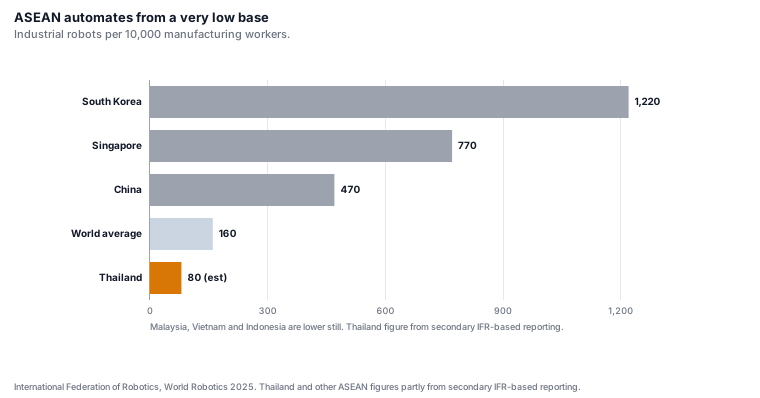
On current evidence, not yet. Robot density, the cleanest proxy for how far automation has gone, shows the gap starkly. South Korea runs about 1,220 industrial robots per 10,000 manufacturing workers and Singapore about 770, both global frontier numbers; the world average is around 160 [9]. Thailand, the most automated of the rest of ASEAN, sits near 80 on the best available estimates, and Malaysia, Vietnam and Indonesia are lower still [9]. The ageing tier is automating fastest in cars and electronics, off a base so low that it is nowhere near the density needed to offset a workforce shrinking by a fifth.
There is also a trap hidden inside the word “AI,” and it is worth separating two very different things. One is AI as hosted compute: the data centres filling Johor and Singapore. That is a genuine investment and power magnet, but it is largely foreign-owned capacity serving foreign demand, and as analysts have noted, data centres rarely throw off the technological and labour spillovers that a semiconductor fab or an advanced factory does [12]. Hosting other people’s compute is not the same as raising your own productivity. The other thing is AI and automation deployed inside domestic firms to do more with fewer workers, which is the version that actually offsets ageing, and which is gated by skills and capital that most of the region is short of. The boom you can see is mostly the first kind. The one that wins the race is the second.
What it runs on: power, skills, capital
Automation, AI compute and an electrified industrial base all draw on the same three inputs, and the ageing tier is constrained on each.
Power is where this brief meets the last one. Every robot, every server hall, every electrified process runs on electricity, and the country with the most acute ageing problem, Thailand, also has some of the most expensive and locked-in power in the region: industrial tariffs exposed to imported gas through the fuel surcharge, and long take-or-pay contracts that a single buyer signed years ago, with direct-purchase access only opening in 2026 and 2027 [17]. The economy that most needs to automate faces a higher hurdle rate on every machine it would automate with. The power-markets layer tracks how far each market has opened.
Skills next. Automation does not run itself; it needs engineers, technicians and a workforce that can be retrained. On the 2022 PISA assessment, Singapore led the world and Vietnam punched far above its income, but Thailand, Malaysia, Indonesia and the Philippines clustered well below the OECD average, and Malaysia’s scores have slipped [10]. The ageing tier’s automation ambitions collide with a thin skills base outside Singapore and Vietnam. Capital is the third input, and it is the least discussed: retooling a factory or a service sector for automation is a capital-intensive bet that small and mid-sized firms in middle-income economies struggle to finance, and the World Bank finds the region’s frontier firms already falling further behind global leaders in exactly the digital-intensive sectors that matter most [13]. The inputs that the race depends on are the inputs the ageing tier is shortest of.
Three scenarios for 2026 to 2045
The framing below is this analyst’s reading of how demographics, productivity, automation and the enabling inputs interact, not a quantitative forecast.
Scenario A: automate and escape. The ageing tier treats productivity as the emergency it is. Power markets open, capital flows to automation, skills programmes scale, and robot density and AI adoption climb fast enough that output per worker rises even as the workforce shrinks. Thailand and Vietnam reach high income before the demographic drag bites hardest; Singapore stays at the frontier it already occupies. Possible, and Singapore and arguably Vietnam show it can be done, but it asks the laggards to raise productivity faster than they ever have, exactly as their margin for error narrows.
Scenario B: a two-speed region. Singapore and Vietnam, the two with the skills base, pull ahead and partly automate their way through ageing. Thailand and Malaysia muddle, automating in autos and electronics but not fast enough across the wider economy, and slide toward the middle-income ceiling. Indonesia and the Philippines, still young, capture manufacturing and AI-adjacent investment, but the quality of the jobs determines whether they convert the dividend or merely rent it out. This analyst’s base case: the divergence the series has tracked widens rather than closes.
Scenario C: old before automated. Reform stalls, power stays expensive and locked in, the skills gap persists, capital for automation does not show up, and the ageing tier hits the demographic wall before the productivity playbook is in place. Growth slows to a crawl, the fiscal squeeze of brief two arrives in full, and the region grows old before it grows rich, and before it automates. Less likely than B across the whole region, but for Thailand specifically it is closer than anyone in Bangkok would like.
Implications
For investors and industrial firms: the question to ask of an ASEAN location is no longer just wage cost or market size. It is whether the workforce is growing or shrinking, whether the power to run automation is cheap and contractable, and whether the skills exist to operate it. Those three answers diverge sharply across the region, and they are now in the data.
For the ageing tier’s policymakers, Thailand above all: the productivity problem is the demographic problem, and it has a deadline. The levers, opening power markets, financing automation, fixing the skills base, are the dull, hard, structural ones, and every year they are deferred is a year of the window gone. The second brief showed the cost of doing nothing arriving through the household. This one shows it arriving through growth.
For the young tier: the dividend is a loan, not a gift. Indonesia and the Philippines have time the ageing tier does not, but the same clock is running, more slowly. The task is to build the power, the skills and the industrial base now, while the workforce is still growing, so that when ageing comes, and it will, the productivity machine is already built.
Korea and Singapore are proof that the machines to keep a shrinking workforce rich already exist. The cruelty is that the economies that most need them can least afford them: the ageing tier got old before it got rich, on thin skills and dear, locked-in power. Thailand has maybe a decade of workforce left to pay for the switch, and it is spending part of that decade subsidising idle gas plants and hosting server farms that employ almost nobody. Nobody chose the demographics. What gets built before the workers are gone is still a choice, and so far it is being made by default, which is to say badly.
References
[1] United Nations, World Population Prospects 2024. Primary source for the demographic figures: working-age share, old-age dependency (Thailand 22 to 50, Singapore 18 to 42, Vietnam 13 to 32 by 2050, medium variant), fertility (Singapore 0.95, Thailand 1.20), and the divergence between the ageing and young tiers. https://population.un.org/wpp/ [2] A1AYN, Regional Demographics and Power Markets layers. Live working-age, old-age-dependency and support-ratio trajectories for ASEAN, and the market-structure layer behind the power constraint. Compiles public-source material into A1AYN’s structured maps. https://a1ayn.com/data/demographics/ [3] World Bank, East Asia and Pacific, rapid-aging analysis (“Live Long and Prosper” and updates). Most of developing East Asia “will grow old before getting rich”; working-age population shrinking more than 10 percent in China, Thailand and Japan by 2040; rising pension and health costs. https://www.worldbank.org/en/region/eap/brief/rapid-aging-in-east-asia-and-pacific-will-shrink-workforce-increase-public-spending [4] IMF, Regional Economic Outlook: Asia and Pacific, April 2017, ch. 2 (“Growing Old before Becoming Rich”). Income at the ageing threshold: Japan and Korea aged at high income, China at roughly a fifth of the US level, several Asian economies ageing at far lower relative income than their predecessors. Per-capita figures are approximate and the comparison is the point. https://www.elibrary.imf.org/display/book/9781475575064/ch02.xml [5] AMRO, “Population Aging in ASEAN+3,” Working Paper (2024); UNESCAP. Speed of the ageing transition: ~18 years for Vietnam and ~20 for Thailand and Singapore to move from ageing to aged, against a century or more in much of the West. https://amro-asia.org/wp-content/uploads/2024/07/AMRO-WP_Population-Aging-in-ASEAN3-But-is-60-the-New-40_July-3-2024.pdf [6] Asian Productivity Organization, APO Productivity Databook 2025. ASEAN TFP growth ~0.6 percent a year (2000 to 2023), contributing ~18 percent of labour-productivity growth versus ~33 percent in East Asia; TFP stagnant 2015 to 2023; the United States holds a 30-plus percent productivity-per-hour lead over the best Asian performers, with only Singapore within single digits. https://www.apo-tokyo.org/wp-content/uploads/2025/10/APO-Productivity-Databook-2025_PUB.pdf [7] Asian Development Bank, on the middle-income trap. Many Asian economies risk being stuck in the middle-income range as the capital-deepening, export-led model runs into slowing productivity and demographic shifts. https://www.adb.org/features/middle-income-trap-holds-back-asias-potential-new-tiger-economies-12-things-know [8] Dani Rodrik, “Premature Deindustrialization,” NBER Working Paper 20935 (2015) / Journal of Economic Growth (2016). Economies reach peak manufacturing employment at lower incomes than early industrialisers, weakening the manufacturing-led productivity escalator and raising middle-income growth risks. https://www.nber.org/system/files/working_papers/w20935/w20935.pdf [9] International Federation of Robotics, World Robotics 2025. Robot density (robots per 10,000 manufacturing workers): South Korea ~1,220, Singapore ~770, China ~470, world average ~160. Thailand, the highest in ASEAN after Singapore, is on the order of 80 (estimate from secondary IFR-based reporting); Malaysia, Vietnam and Indonesia are lower. https://ifr.org/wr-industrial-robots/ [10] OECD, PISA 2022 Results (Volume I). Singapore first in the world; Vietnam well above its income level; Thailand, Malaysia, Indonesia and the Philippines below the OECD average, with Malaysia’s scores having fallen since 2018. https://www.oecd.org/en/publications/pisa-2022-results-volume-i_53f23881-en.html [11] McKinsey Global Institute, “A future that works” and “How productivity can save an ageing world.” With ageing, productivity growth must accelerate by roughly 80 percent to maintain living standards; automation is the principal available lever. https://www.mckinsey.com/mgi/overview/in-the-news/how-productivity-can-save-an-aging-world [12] The Diplomat, “Southeast Asia’s AI Dilemma” (April 2026). The data-centre build-out in Johor and Singapore is largely foreign-owned hosted compute serving foreign demand, with limited domestic technological and labour spillover relative to advanced manufacturing. https://thediplomat.com/2026/04/southeast-asias-ai-dilemma/ [13] World Bank, East Asia and Pacific, “Firm Foundations of Growth” (2025). The region’s frontier firms are falling further behind global leaders, especially in digital-intensive sectors, constrained by skills, financing and uneven digital infrastructure. https://www.worldbank.org/en/region/eap/publication/firm-foundations-of-growth [14] A1AYN, “ASEAN’s electricity decade” (2026). The companion brief on the region’s power opportunity and the grid, finance and market-structure constraints on building the clean-power base that automation and AI compute depend on. https://a1ayn.com/blog/asean-power-opportunity-2026/ [15] A1AYN, “ASEAN’s demographic divergence” (2026). The first brief in this series: the split between the ageing and dividend-window economies, and why a young workforce is necessary but not sufficient for industrialisation. https://a1ayn.com/blog/asean-demographic-divergence-2026/ [16] A1AYN, “In Thailand the family is the pension system, and it is shrinking” (2026). The second brief: how the fiscal cost of ageing lands on households in a country with a thin public pension. https://a1ayn.com/blog/who-carries-an-ageing-thailand-2026/ [17] Thailand industrial power cost (Nation Thailand; SDG Move; A1AYN electricity-costs layer). Industrial tariffs exposed to imported gas through the fuel surcharge, long take-or-pay contracts under a single buyer, and direct-purchase access only opening in 2026 to 2027. https://a1ayn.com/data/electricity-costs/
Demographic figures are UN World Population Prospects 2024 (medium variant) as compiled in the A1AYN demographics layer. Income-at-ageing, productivity, robot-density and skills figures are World Bank, IMF, APO, IFR and OECD estimates; the income-at-threshold comparison is approximate and the ordering is the point. Robot-density figures outside Korea and Singapore rest partly on secondary IFR-based reporting. Current as of June 2026.