Europe has a plan for the green transition. There are targets for solar and wind, a date by which new cars are meant to be electric, timetables for heat pumps and grids and hydrogen. What it does not have, or has only begun to sketch, is a plan for the world this transition has to be built in. The plan was written for a world that more or less cooperates, where the inputs can be bought from whoever happens to make them most cheaply. That world is fading. The one taking its place is multipolar and competitive, and the place the change shows up first is in the metals that the whole transition runs on.
The Critical Raw Materials Act is the European answer so far [1]. It sets non-binding benchmarks for 2030: a tenth of our own demand to be mined inside the bloc, two-fifths to be processed here, a quarter to come from recycling, and no more than 65 percent of any one strategic material from a single outside country. Since it passed, the conversation about supply has mostly been about permitting and political will, as though the obstacle were the time it takes to approve a mine. For some metals that is roughly true. For rare earths it is not, and rare earths are worth dwelling on because they are the clearest example of a problem that also applies, in weaker form, to nickel and lithium and graphite.
The screen behind this brief checks every deposit’s products against live prices, and sits on the Finnish mining page, with the rare-earth case shown on two routes. It is an operating-cost screen, not a feasibility study: it asks whether the cash margin survives at today’s prices, and it leaves out capital cost entirely.
The argument that should be right, and isn’t
The reassuring version goes like this. China dominates rare earths today, but markets correct. If China ever restricted exports, the price of rare earths would rise. At some higher price, mining and processing them outside China would become profitable, companies would invest, and supply would rebuild itself elsewhere. This is ordinary supply and demand, and for most commodities most of the time it is how things actually work. I assumed it worked here too.
It does not, and the reason has little to do with how much rare-earth ore exists. There is plenty, in many countries, including inside the EU. The ore is not the constraint. The constraint is what you have to do to the ore afterwards.
A rare-earth deposit does not give you neodymium or dysprosium. It gives you a mixture of the fifteen lanthanides, the chemically near-identical elements that sit next to each other on the periodic table, to which the rare-earth group conventionally adds yttrium, all bound up together in the same minerals. To get the individual oxides that a magnet factory can use, you have to separate them from one another, and because they are so alike, separating them is genuinely difficult. The industrial method is solvent extraction: the mixture is passed through a long cascade of liquid stages, sometimes more than a hundred, each one nudging the elements very slightly apart, until at the far end you have pure single-element streams. It is slow, chemically demanding, energy- and reagent-hungry, and it produces waste that includes the thorium and uranium that rare-earth ores tend to carry.
This separation step, not the digging, is where most of the cost lives. A reviewed techno-economic study puts it at about two-thirds of the total cost of going from ore in the ground to oxide ready for use [2]. And it is the step China has spent decades making cheap. Industry cost curves put the lowest-cost Chinese separation at around eleven dollars per kilogram of finished oxide, with full separation in the West generally estimated in the twenty-to-fifty-dollar range and described as uneconomic at recent prices [3]. That cost difference does not disappear when prices rise, because separation is something every kilogram has to go through regardless of what the finished oxide sells for.
What is actually in the rock
The economics get harder once you look at the mixture itself. A typical light rare-earth deposit, of the kind found in Finland’s Sokli or in California’s Mountain Pass, is dominated by cerium and lanthanum. Those two make up well over half the material by mass, and both are cheap, because the world produces far more of them than it can use. The valuable part is a much thinner slice: neodymium and praseodymium, the elements that go into the permanent magnets in electric motors and wind turbines, with a little of the scarce heavy rare earths if you are lucky enough to have them. Sokli, like most carbonatite deposits, is light-rare-earth material; in the screen its value is carried almost entirely by neodymium and praseodymium, with very little uplift from the heavy rare earths, the exact split being a screening assumption rather than a published assay [5].
So you are paying to process the entire mixture while only a small fraction of it carries real value. The average kilogram of total rare-earth oxide you handle is worth a good deal less than it costs to separate that kilogram cleanly outside China. On the screen, the realised value of a Sokli-type basket comes to roughly fifteen to thirty dollars per kilogram depending on which price deck you use, against a Western separation cost in the same range or higher [3][5]. The two overlap, which is another way of saying the operating margin sits around zero or below before a cent of capital is counted.
Running the experiment
Now put the reassuring argument to the test. The natural move is to ask what price would make ex-China supply viable, and here we have a policy-revealed answer rather than a market one. In July 2025 the United States Department of Defense agreed to underwrite MP Materials at a hundred and ten dollars per kilogram of neodymium-praseodymium oxide, against a Chinese price around sixty, through a contract for difference, meaning that whenever the market falls below that level the government pays the producer the gap [4]. That figure is not what buyers freely pay in an open market. It is what one government judged necessary to make domestic capacity financeable. Independent industry analysis lands in the same territory, putting the NdPr price needed to incentivise non-Chinese supply at roughly seventy-five to a hundred and five dollars per kilogram, well above the Chinese level [3].
Even those supported numbers do not clear a deposit like Sokli on the screen. Feed a Western separation plant with Sokli material and the separation cost still swallows the operating margin. The break-even is simple to state: the gross basket price has to reach the separation cost divided by the realisation factor, which for Sokli is roughly forty dollars over nine-tenths, or about forty-four dollars per kilogram, against something near twenty-nine at today’s already-elevated ex-China prices [5]. So the basket would have to rise by about half again just to cover separation, before any profit and before the capital is repaid. Higher prices help only if they outrun the Western cost, and today’s premium does not get there.
There is a single fact that captures all of this more economically than the arithmetic. Mountain Pass is the strongest rare-earth asset outside China: high grade, already in production, run by a capable and well-capitalised company. It still could not finance a domestic separation chain on ordinary commercial terms. For years it shipped its concentrate to China to be separated, because that was the only place it made economic sense. The capacity it is now building in the United States rests on the Department of Defense having become, in July 2025, its largest single shareholder, with a four-hundred-million-dollar equity stake, a separate loan toward heavy rare-earth separation, a ten-year commitment to buy its magnets, and the guaranteed price already described [4]. When the best private asset in the West needs a defence ministry as its largest investor and its price-setter, the private economics are not standing on their own.
I should say plainly that I did not find this easy to accept. A few specialists have been making this argument for years, and it has always sounded like the kind of thing a domestic producer says when it is angling for a subsidy. What persuaded me was working through the figures rather than the rhetoric, and finding that independent analysts and a defence procurement office had arrived at the same place. They are not a forecast and they are not a political position. They are a cost subtracted from a price, and for the Western route the result is negative.
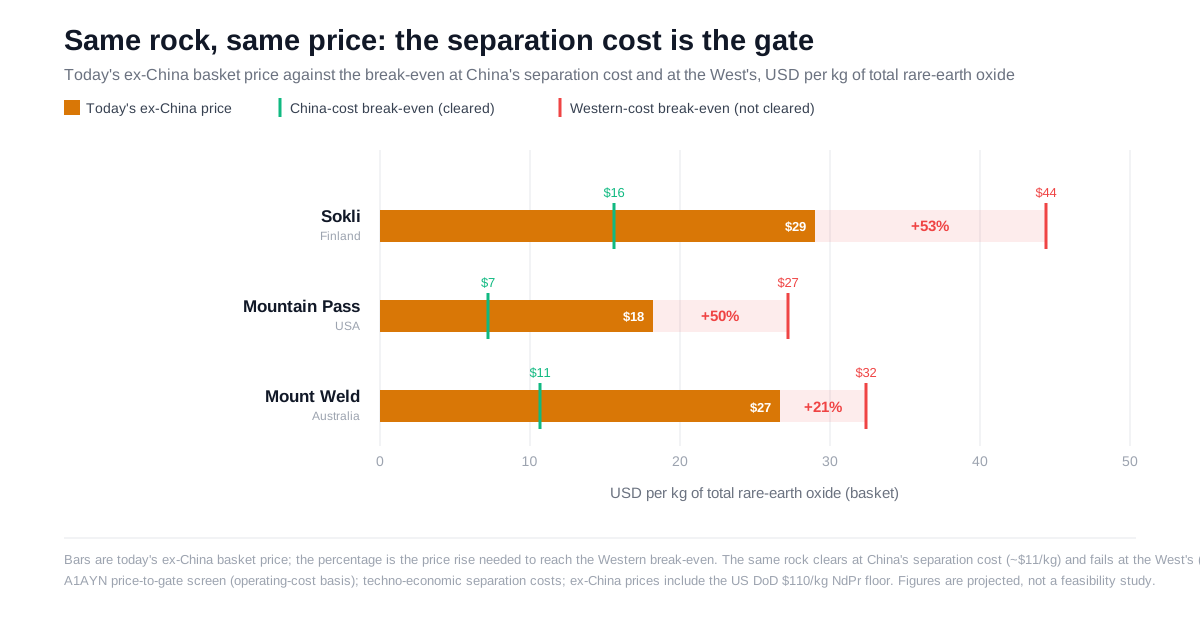
The screen behind the chart is deliberately simple and its assumptions are open on the mining page [5]. Each deposit’s basket of oxides is valued at live or referenced prices, cut by a realisation factor for logistics and product quality, and compared against a China-toll and a Western-build separation cost; the break-even is the gross basket price that covers separation after the realisation cut. It is an operating-cost cut-off and excludes capital, sustaining capital, royalties, taxes and financing, so a deposit that clears it has cleared the easy test, not the hard one. The full arithmetic, including the per-element basket, is set out in the appendix.
What China actually did
It is worth being clear that none of this happened by accident, and that the lesson is not really about rare earths at all. Deng Xiaoping is supposed to have said in 1992 that the Middle East had oil and China had rare earths. Whether or not the quote is exact, the strategy it describes is real and was followed for the next thirty years. China took the part of the chain that everyone else wanted to be rid of, the dirty, capital-intensive, low-margin separation and refining, and invested in it steadily until it was both the cheapest and the largest. It built the cascade-extraction expertise, the trained chemists, the plants, the supply of reagents, and the regulatory tolerance, decade after decade, while Western firms concentrated on the higher-margin end and were content to import the separated product.
The result is concentration with very few parallels in any industry. China ran about 91 percent of the world’s rare-earth refining in 2024 and about 94 percent of finished magnet manufacturing [6]. The deposits are spread across the planet; the ability to turn them into usable metal sits almost entirely in one country. We arrived here through a long sequence of individually reasonable decisions, each one offshoring an unglamorous process to whoever would do it most cheaply, without anyone deciding that the cumulative result was a strategic dependency. It is fashionable to reach for Sun Tzu when describing China’s conduct. The more useful and more boring lesson is that strategic position is built slowly, by whoever is willing to do patient and unrewarding work while the other party optimises for the next quarter.
Not only rare earths
Rare earths are the sharpest case because the separation step is so uniquely hard and so uniquely concentrated, but the underlying pattern is more general. The same structure, in which the West mines or could mine the raw material but China controls the processing, recurs across the inputs to the energy transition. China refines the majority of the world’s lithium even though most of it is mined in Australia and South America. It produces the overwhelming share of the graphite anode material that goes into every lithium-ion battery. In nickel, the growth has been in Indonesian ore processed largely through Chinese-built and Chinese-financed plants. The deposits sit in many countries; the midstream, where raw material becomes battery-grade input, has been allowed to concentrate.
The scale of the catch-up is the part that should focus minds. The IEA estimates that even if every announced project is built, capacity outside China in 2035 would still cover only about half of ex-China mining demand for magnet rare earths, a quarter of refining demand and under a fifth of magnet demand, and that closing those gaps would take roughly two, four and six times the expansion already planned, in mining, refining and magnets respectively [6]. The binding constraint is not finding or permitting mines, which is where European policy has put most of its attention. It is rebuilding processing that does not pay for itself at market prices, against an incumbent that spent decades making sure it would not.
Pray, or pay
That leaves two broad options, and neither is comfortable.
The first is to carry on and hope. Trust that Chinese supply is never seriously interrupted, by an export licence, a tariff, or a wider confrontation, and keep importing finished magnets and refined metals the way we always have. This is the path of least resistance and it is more or less the one we are on. It rests on the assumption that a country which spent a generation acquiring a choke point will choose never to use it, which is a large assumption to build an industrial transition on, particularly given that China has already restricted exports of gallium, germanium and some rare-earth processing technology in recent years.
The second is to pay, and to do it more deliberately than the current framework manages. The Critical Raw Materials Act improves permitting, coordination and access to existing finance, and strategic-project status opens real doors, to a financing subgroup, to public and national funds, and to help arranging offtake [1]. What it does not do is close a margin that is negative before private capital will commit. It is not, in itself, a price floor, an offtake backstop or a public-equity vehicle, and those are the instruments a market needs when it cannot on its own supply a good that carries strategic value. The American approach, a defence department writing cheques and setting prices, is blunter and in a sense more honest than ours, because it admits openly that the market will not do this and that the state will have to. A European version would not need to copy the military framing, but it would need comparable money, and considerably more than the permitting reforms offered so far.
What this is not is mainly a case for lowering standards. A weaker environmental rule could shave reported costs by externalising waste, tailings and the handling of the radioactive thorium and uranium that come with the ore, and the IEA does count stricter requirements among the reasons Western processing costs more. But it would not touch the core drivers: the difficult chemistry, the long solvent-extraction trains, the reagents, the energy, the equipment and the scale. The expense is mostly physical, and treating it as a regulatory artefact would aim effort at the wrong target while leaving the actual gap untouched.
The green transition was designed, implicitly, for a cooperative world in which the cheapest supplier could always be relied upon. It now has to be built in a competitive one, in which the cheapest supplier is also a strategic rival who understands exactly what it controls. Wanting the transition has never been the hard part. Paying for the parts of it that the market will not provide, before the supply is interrupted rather than after, is the test Europe has not yet been willing to sit.
Appendix: how the break-even is computed
The chart’s numbers come from a deliberately simple operating-cost screen. For each deposit:
gross basket ($/kg TREO) = sum over oxides of (mass fraction × oxide price on the chosen deck)
realised        = gross × realisation factor
margin per kg   = realised − separation cost
gate per t ore  = (kg TREO per t ore) × margin per kg − mill cost
break-even gross = (separation cost + mill ÷ kg TREO) ÷ realisation
price rise needed = break-even ÷ today's price − 1
Worked through for Sokli, on the ex-China (security-premium) price deck. A tonne of ore at 0.7 percent total rare-earth oxide and 60 percent recovery yields 4.2 kg of mixed oxide. That mixed kilogram is worth about 29 dollars at ex-China prices, and almost all of that value is two elements:
| Oxide | Mass share | Price, $/kg | Value, $/kg basket |
|---|---|---|---|
| Neodymium (Nd₂O₃) | 16% | 110 | 17.60 |
| Praseodymium (Pr₆O₁₁) | 5% | 95 | 4.75 |
| Dysprosium (Dy₂O₃) | 0.5% | 800 | 4.00 |
| Terbium (Tb₄O₇) | 0.1% | 1,500 | 1.50 |
| Cerium (CeO₂) | 48% | 1.5 | 0.72 |
| Lanthanum (La₂O₃) | 25% | 1.0 | 0.25 |
| Samarium, yttrium, others | rest | low | 0.20 |
| Gross basket | 29.0 |
Neodymium is 16 percent of the mass and 61 percent of the value, which is why the cheap cerium and lanthanum that make up most of the rock barely move the economics. Realised at a 0.90 factor, the kilogram is worth 26.1 dollars. Against a Western separation cost of 40 dollars, the margin is minus 13.9 dollars per kilogram, or minus 58 dollars per tonne of ore. The basket has to reach 40 ÷ 0.90, that is 44.4 dollars, to break even, against 29 today, a rise of 53 percent.
The same arithmetic across the three deposits:
| kg TREO per t ore | Basket today, $/kg | Western sep, $/kg | Mill, $/t | Break-even, $/kg | Price rise needed | |
|---|---|---|---|---|---|---|
| Sokli | 4.2 | 29.0 | 40 | 0 | 44.4 | +53% |
| Mountain Pass | 45.5 | 18.2 | 25 | 40 | 27.2 | +50% |
| Mount Weld | 24.6 | 26.7 | 28 | 45 | 32.4 | +21% |
Inputs and their status. Oxide prices on the ex-China deck use the US Department of Defense floor of 110 dollars for neodymium-praseodymium and European levels for the heavy rare earths [3][4]; separation costs use the cost-curve range, roughly 11 dollars per kilogram in China and 20 to 50 in the West [3]; grades and recoveries are representative figures from company and survey reports; the basket composition is deposit-specific for Mountain Pass and Mount Weld and a generic light-rare-earth carbonatite proxy for Sokli, pending an assay; the realisation factor, 0.90 to 0.95 for these rare-earth cases, is a haircut for logistics and product quality. The screen excludes capital, sustaining capital, royalties, taxes and financing, so clearing it is the easy test, not the hard one.
References
[1] Regulation (EU) 2024/1252, the Critical Raw Materials Act (of 11 April 2024; entered into force 23 May 2024). Sets non-binding 2030 benchmarks for extraction, processing and recycling of strategic raw materials, plus a strategic-projects regime that eases permitting and improves access to existing finance and offtake support without a dedicated funding instrument of its own. https://eur-lex.europa.eu/eli/reg/2024/1252/oj
[2] Smerigan et al., Toward Sustainable Rare Earth Element Production: a techno-economic review (2025). Reviewed studies place rare-earth separation and refining at roughly two-thirds of the cost from mining through refining, with typical basket prices around USD 15–55/kg REE; notes the non-China routes that ship concentrate to Malaysia or, historically, to China for separation. https://arxiv.org/abs/2506.22569
[3] Rare Earth Exchanges, US rare-earth production cost curve (2025), with Project Blue and Benchmark Mineral Intelligence inputs. Lowest-cost Chinese total-REO production at ~USD 11/kg; full US separation uneconomic at recent (2023-level) prices; an estimated NdPr incentive price of ~USD 75–105/kg to bring on non-Chinese supply; Western advanced-stage separation OPEX commonly placed at ~USD 20–50/kg. https://rareearthexchanges.com/news/rare-earth-exchanges-calculating-a-cost-curve-for-u-s-rare-earth-production-select-elements/
[4] US Department of Defense / MP Materials public-private partnership (announced 10 July 2025). A USD 110/kg floor for NdPr oxide via a contract for difference (against ~USD 60/kg in China), a USD 400m convertible-preferred equity stake making the DoD the largest shareholder (~15%), a USD 150m loan toward heavy rare-earth separation, and a 10-year magnet offtake; plus the long prior history of shipping Mountain Pass concentrate to China for separation. https://investors.mpmaterials.com/investor-news/news-details/2025/MP-Materials-Announces-Transformational-Public-Private-Partnership-with-the-Department-of-Defense-to-Accelerate-U-S—Rare-Earth-Magnet-Independence/default.aspx
[5] A1AYN, price-to-gate screen, Finnish mining page. Operating-cost cut-off per product at live prices, with rare earths on the China-toll and Western-build routes, the realisation factor, the separation-cost decks and the break-even basket price; assumptions and exclusions (capital, sustaining capital, royalties, taxes, financing) are set out on the page. https://a1ayn.com/data/mines/
[6] IEA, Rare Earth Elements (2025). China at ~91% of rare-earth refining and ~94% of finished magnet manufacturing in 2024; ex-China capacity in 2035, even with announced projects, covering only ~50% of mining, ~25% of refining and under 20% of magnet demand outside China, requiring roughly two, four and six times the planned expansion respectively. https://www.iea.org/reports/rare-earth-elements-2025
These are operating-cost figures, not a full feasibility study. They show whether the cash margin survives at today’s prices, not whether the entire investment including capital clears, which is a separate question. Separation-cost ranges are from the industry sources in [2] and [3]; live base and precious-metal prices refresh weekly on the mining page. As of June 2026.