For years Europe has had the luxury, even the pleasure, of someone else’s problem. The EU’s Green Deal was built on the sweat, tears and blood of places as distant to most Europeans as Mars: cobalt from Congo, nickel from Indonesia, lithium from a salar most of us could not find on a map. We detached ourselves from where the metals come from, and we slept. It is a luxury we can no longer afford.
China did not sleep. It played the long game, and today Europe’s industrial base is held hostage. For most of the materials the energy transition runs on, China is the dominant refiner. The numbers, material by material, are on the critical-materials page [19], and they are not in dispute [4]. The fantasy we tell ourselves is that we can outpace China at the top end and stay relevant that way, holding the “premium” ground in cars, the high ground in lithography. It has never worked. Good enough and cheaper has always beaten the “best” in the end, and then, given time, walked off with the trophy of best as well. Europe built the market for solar power. China took the factories, and makes more than eight in ten of the world’s panels now [21].
The legislation, at last, has taken the right step. The Critical Raw Materials Act puts numbers and deadlines on European supply, and I will come to its limits. But the thing Europe is short of is not a law, and not even the ore, which half a dozen member states are sitting on. It is public trust: the social and legal licence to dig the rock up at home, in front of people who will not accept “somebody else’s problem” as an answer once the problem is theirs. Finland has the closest thing in the bloc to an answer. It is openness.
The cluster and the contested projects sit on the Finnish mining page [17]; the worked example, the open record below a single discharge, is at /data/mine-water/ [18]. I am writing this on 27 June 2026. The edge is real and it is structural. It is also easy to oversell, if you forget how much still has to go right.
The demand is now law
For most of the last decade, the idea that Europe should dig up more of its own metals was a sentiment, the sort of thing a commissioner says and a newspaper prints and no one funds. In 2024 it grew teeth. The Critical Raw Materials Act, Regulation (EU) 2024/1252, was adopted on 11 April 2024 and entered into force on 23 May. It names 17 strategic and 34 critical materials and writes four numbers into law for 2030: mine at least a tenth of what the bloc consumes of each strategic material inside the bloc, process at least 40%, recycle a quarter, and take no more than 65% of any one of them from a single country outside it [1].
That last number is the one that does the work, and it is aimed at a country the Act is too polite to name. For 19 of the 20 minerals the IEA tracks, China is the leading refiner, around 70% of the market on average, nearer 90% for rare earths and above 90% for graphite [4]. A 65% ceiling, set against numbers like those, reads less like a limit than an instruction. It is a Union-wide benchmark, not a procurement law binding any single buyer, but it changes the gravity of the whole system: find the tonnes somewhere else, and to anyone who can supply them from inside the bloc, there is now a target and a financing case behind building. The Commission put status and money behind it, naming 47 Strategic Projects across 13 member states in March 2025, €22.5 billion of planned investment between them [2].
So the demand is there, and now it is written down. Whether Europe can answer it by 2030 is another matter, and the arithmetic has mostly settled that already.
Europe legislated demand it cannot permit fast enough
A benchmark for 2030 quietly assumes you can build the mines to hit it between now and then. You cannot. The IEA looked at the major mines that came online between 2010 and 2019 and found they took, on average, 16.5 years from discovery to first production: more than twelve years of drilling, studies and permits, then four or five of construction [5]. S&P Global ran the same exercise over 127 mines and landed at 15.7 [6]. Whatever Europe wants out of the ground in 2030 is already either built, being built, or not arriving in time. A deposit found this morning produces in the 2040s.
The 2030 extraction target, then, is close to already decided. It will be met, or missed, by the mines that exist or are already being built, give or take what brownfield expansions and restarts can add at the margin. For a new greenfield deposit, permitting started now moves 2035 and 2040, not 2030.
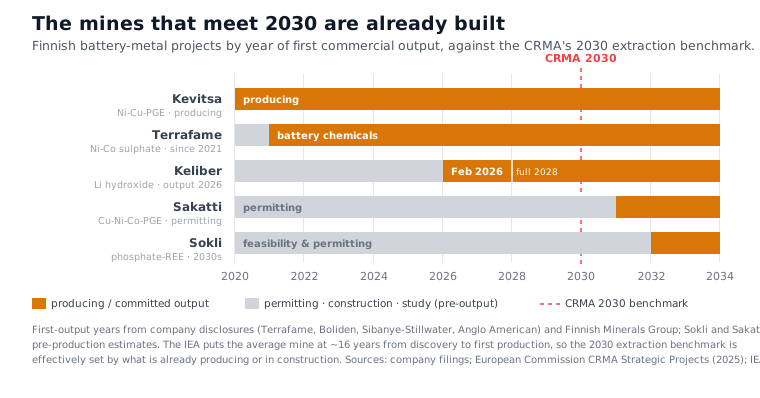
Put Finland’s battery-metal projects on that clock and the split is plain. Two are already producing. Keliber crossed into mining this year and targets full capacity in 2028. The two big new deposits, Sakatti and Sokli, deliver their first metal in the 2030s however cleanly the permitting goes. That is not a Finnish failing; it is the physics of building a mine, and it points at the half of the Act nobody puts on a poster. Everyone quotes the 10% for extraction. The number that is both larger and reachable in time is the 40% for processing, because a refinery is built in low single-digit years, not fifteen. Refining is also the precise stage China owns. The hole in the ground is the part everyone pictures; the refinery is the part that decides who depends on whom, and it is the part Finland is building now.
The scarce asset is a place you can build a mine
Demand is settled, and timing with it. What is still genuinely in play is the thing the geology reports never measure: whether a deposit turns into a financed, insured, working mine, or just a resource statement with a court case attached. Ore is not the scarce input. Spain, Portugal, Sweden, Greece and the Balkans all have deposits in the ground; turning one into a mine that can actually be built and financed is the part that defeats them, and that plays out in the village halls and the courtrooms, not the drill logs.
Two mines, same continent, same metal, the same EU label, tell the whole story. In November 2025 Rio Tinto put Jadar into care and maintenance. Jadar is one of the largest undeveloped lithium deposits in Europe, big enough on its own to cover a real slice of the continent’s battery demand, and the Commission had named it a Strategic Project only months before [3]. None of that saved it. Serbia revoked the spatial plan in 2022 after mass protest, a court reinstated it in 2024, the protests came back, and Rio Tinto put the project down. Its own language is capital discipline; by any reading the political and social-licence risk is what made Jadar unbankable [7]. The ore is still in the ground. The metal is still wanted. What Serbia could not produce was a durable licence to dig it up, and no benchmark in any regulation manufactures one.
Three months later, on 12 February 2026, a mine in western Finland simply started. Keliber put its first ore through at Syväjärvi, the front end of what is set to become the EU’s most advanced integrated lithium operation: a quarry, a concentrator at Päiväneva, and a refinery at Kokkola designed to turn the concentrate into battery-grade hydroxide [10]. The mine and concentrator come first; the refinery is staged behind them, its commissioning deferred on a lithium price that has since fallen hard. Same metal, same label, opposite direction. Geology did not decide it.
What Finland has is not a guarantee. It is a licence you can actually build, which is rarer. The country runs a codified mining law and a public permitting register through Tukes, the safety and chemicals agency. It has GTK, the geological survey that found most of the deposits now in production and publishes the bedrock maps an outsider can use to check a claim. It has a state catalyst, Finnish Minerals Group, putting public equity into the projects the market would not start alone. And it runs a water-permitting system that is slow, adversarial and genuinely able to refuse, which is exactly what makes its consent worth financing. Slow is not blocked. In November 2025 the Administrative Court of Northern Finland annulled four of Anglo American’s own Sakatti exploration permits on the Viiankiaapa mire, not on a whim but over deficient permit terms and inadequate protection for the area’s eagle nests, and sent them back to Tukes to be written properly; the company’s other permits there still stand [9]. That is a separate track from the mine’s Natura assessment, which was judged sufficient the same year [8]. Underneath both sits the real constituency of a northern mine: a protected aapa mire, reindeer-herding cooperatives, eagle nesting sites, the municipalities and residents with a statutory say, and, further north, Sámi rights. None of that makes a project impossible. It makes consent something you earn slowly and on the record, and it is why the process arrives at an answer a bank can underwrite instead of a standoff with no end and no number.
Finland’s cluster, mine by mine
Finland is widely reckoned the EU’s most active metal-mining country, and the concrete claims are unambiguous: Europe’s largest gold mine at Kittilä, the bloc’s only chromium mine at Kemi, and the only domestic production of cobalt and phosphate anywhere in the Union [14][16]. No single mine carries the argument. The chain does, because it runs from rock to refined chemical inside one country, and it is unusually far along.
| Project | Place | Product | Status, mid-2026 |
|---|---|---|---|
| Terrafame | Sotkamo | Ni + Co sulphate | Producing. Battery-chemicals line since 2021: 170,000 t/yr nickel sulphate, 7,400 t/yr cobalt sulphate. State-controlled via Finnish Minerals Group [11][12]. |
| Kevitsa | Sodankylä | Ni-Cu-PGE | Producing. One of Europe’s larger nickel-copper-PGE operations (Boliden) [16]. |
| Keliber | Kaustinen / Kokkola | Li hydroxide | Mining began Feb 2026; concentrator commissioning planned for 2026, the Kokkola refinery staged behind it and deferred on lithium prices; steady state targeted 2028. 79.8% Sibanye-Stillwater, the rest the Finnish state. Set to be the EU’s first integrated mine-to-refinery lithium chain [10]. |
| Sokli | Savukoski | Phosphate + REE | Feasibility plus pilot mining and concentration 2026-29 (pilot phosphate and iron concentrate 2027-29) after a €65m state capitalisation; reserves could meet up to a fifth of EU phosphate demand; commercial output in the 2030s [13]. |
| Sakatti | Sodankylä | Cu-Ni-Co-PGE | Permitting. An EU Strategic Project; the Natura assessment was judged sufficient in 2025. First output early 2030s [8]. |
The integration is the whole point. Terrafame does not ship ore; it ships nickel and cobalt sulphate, the actual stuff that goes into a cathode, from a site wholly inside the European chain. Keliber will not export spodumene; it is built to refine to hydroxide at Kokkola, once the refinery is commissioned. That is the 40% processing benchmark taking physical shape while most of the bloc still argues about the 10% for extraction. The state assembled this cluster on purpose, piece by piece, and it is exactly what a buyer locked out of Chinese refining is shopping for.
The uncomfortable gift
Every honest account of Finnish mining goes through Talvivaara. On 4 November 2012 a gypsum pond at the Talvivaara nickel mine failed; about 1.2 million cubic metres of metal-bearing, uranium-bearing water leaked from it, some 240,000 of that beyond the mine into the watersheds north and south [15]. The environment minister called it a serious environmental crime. The company was bankrupt by 2014. In 2015 the state took the wreck over and rebuilt it as Terrafame [15]. That is the scar every Finnish project is now measured against, and it should be. It is also, and this sounds perverse until you look at the record, the strongest card the country holds.
Below Terrafame’s discharge sits Lake Nuasjärvi, and SYKE, the state environment institute, measures both halves of the question there in the open, year after year [20].
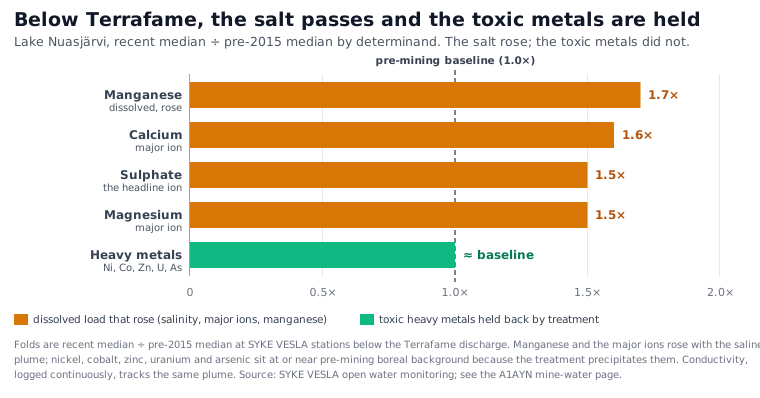
The salt rose. Sulphate, calcium, magnesium and manganese all sit well above where they were before 2015, because the dense, saline mine water is the one thing the treatment cannot pull back out, and a continuous conductivity probe below the pipe follows that plume as it sinks, stratifies and turns over with the seasons [18]. This is not cosmetic. A peer-reviewed study of the lake found the salinated discharge deepened the stratification, starved the bottom water of oxygen near the pipe, and degraded the benthic community there toward something resembling a heavily polluted lake, even as the open-water life further off changed little [22]. The salt is a real, measured, continuing harm, and the record does not let anyone pretend otherwise.
What the same record also shows is that the metals which made Talvivaara a catastrophe, the nickel and cobalt and zinc and uranium and arsenic, read close to background across the lake, because the discharge is neutralised and neutral water drops them out of solution. Held back, not gone: the discharge bay itself still carries nickel many times the level out in the open lake [18]. So the mine that caused the worst environmental failure in Finnish memory now runs one of Europe’s largest nickel-sulphate lines, its heavy metals near background and its salinity still stratifying the lake below it. None of it is hidden. That is the point.
Here is why that matters more than it sounds. For a long time Europe was perfectly comfortable with mining, on one condition, that it happened to someone else: the cobalt, the nickel and the lithium we started with, dug somewhere far enough away to stay out of mind. Somebody else’s problem is a wonderfully efficient category, because a problem filed under someone else is one you never have to look at. Talvivaara ended that. It happened in Finland, to Finns, in a lake people swim in, and there was nowhere to file it.
That is the uncomfortable gift. An open record lets a country be caught, and then checked: the 2012 failure was there for all to see, the state took the mine over, the treatment holds the metals even as the salt keeps degrading the deep water, and anyone, a lender, an insurer, a smelter buying the offtake, a village on the shore, can pull the public data and decide for themselves what to make of it. Read that record more closely, with depth and chemistry resolved, and it gives up things nobody went looking for, the enriched bay among them, and with it any liability an operator might have preferred to leave unwritten. None of those people has to take the company’s word. They can look. Openness is not consent, and it should not be mistaken for it: a community that can see every number is also better armed to refuse, and sometimes will. What it produces is not agreement but a trust you can audit, which is the only kind worth pricing. Serbia never got that far, because the fight at Jadar was over before it produced a single number anyone trusted. Europe gave that away for two decades, every time it arranged for the mining, and the looking, to happen out of sight.
The audit runs both ways. Anyone can also weigh what the company says against what the lake shows: Terrafame reports its sulphate discharge each year against a permit ceiling, 10,088 tonnes in 2025 against a quota of 15,780 [23], and the open record below the pipe is there to test that figure rather than take it on faith. The lake confirms the large moves: when the plant ran closed-cycle in 2018 and reported a third of its usual load, its own sulphate fell with it [18]. The fine tonnage still rests on the operator’s metering, because an outflow carries a whole catchment and not one mine, so auditable is again not the same as proven. It is still a long way better than a brochure.
Three scenarios for 2026–2035
These are scenarios, not predictions. A way to hold the uncertainty still long enough to look at it, nothing more.
Finland executes. The government grants Sakatti the Natura exemption it is waiting on, the environmental permit follows, and Sokli moves off the feasibility bench toward a build. Keliber commits the Kokkola refinery and ramps to full hydroxide, Terrafame holds its discharge envelope, and a second refining tenant turns up at Kokkola. Finland becomes the bloc’s anchor for the 40% processing target and a visible, if modest, contributor to the 10%. This is the central case as long as permitting holds the line it is on today.
Processing wins, on thin margins. The new mines slip, the way mines do, Sakatti into the second half of the 2030s and Sokli further still, and the EU misses its 10% extraction benchmark across the board. Finland’s edge holds anyway, because it was always the refined end. Keliber, Terrafame and the chemical cluster keep scaling on imported and domestic feed alike, and the country becomes the place where non-Chinese units turn into battery-grade product. The catch is price. Lithium and nickel have fallen far enough that Keliber has already deferred its refinery and the sector is taking impairments, and if China keeps its refined-material overcapacity pressure on, non-Chinese supply can be strategically valuable and commercially fragile at the same time. Likeliest path on a ten-year view, because refining is quick and mining is slow, but the economics are the open question now, not the geology.
The room runs out. A court ruling or a lost social licence freezes Sakatti the way Jadar froze, the contested restart at Hannukainen stays contested, and the friction that annulled those exploration permits in 2025 reaches the mining permits. Finland’s advantage is institutional, and institutions are perishable. Lose the room at one flagship and the trust premium the whole case rests on starts to leak away. Less likely than the first two, but it is the risk that actually bites, and the reason to watch the Sakatti decision rather than the press releases.
Implications
For mining investors and developers: in Finland the binding constraint is the water permit and the Natura assessment, not the resource statement. Underwrite the permitting calendar and the social licence with the same rigour you give the orebody, because Jadar is where the other kind of capital went to die. Finland prices that risk lower than almost anywhere in Europe. It does not price it at zero.
For lenders and insurers: the open monitoring record is an input to your model, not a compliance cost you make the borrower carry. A discharge with decades of public, station-level chemistry and a live conductivity series is one you can check yourself, and a risk you can check is a risk you can price. That is a feature of Finnish assets, and whoever learns to read the record will underwrite them better than the desks still treating “a mine in a sensitive catchment” as one undifferentiated red flag. Today that underwriting is mostly done by the state and the development banks, the EIB and the export-credit agencies, because the commercial desks have not arrived; the open record is how you bring them in, not proof that they are here. If there is a business hiding in this brief, it is here.
For EU policymakers: the 2030 extraction number is already fixed by what is in the ground today, so the live levers are the ones that move 2035, processing capacity and permitting throughput. Naming more Strategic Projects changes nothing while the courts and the Natura exemptions remain the real schedule. Fund the refineries. Fix the permitting clock.
For Finland: the advantage is institutional, and it is on loan. The mining law, GTK, Finnish Minerals Group and the water regime are the reason a deposit here is more trusted than the same rock in Serbia. Spend that credibility carelessly, lose the room at Sakatti or Hannukainen, and the country becomes Serbia with snow, rich in ore and unable to build. Keep the consent real and the water honest, and Finland is the most financeable place in Europe to mine the metals the energy transition runs on. The metal was never the hard part. Trust is the product.
References
[1] Regulation (EU) 2024/1252 (Critical Raw Materials Act). 2030 benchmarks (10% extraction, 40% processing, 25% recycling, 65% single-country cap), Article 5; Annex I strategic and Annex II critical materials. Adopted 11 April 2024, in force 23 May 2024. EUR-Lex: https://eur-lex.europa.eu/eli/reg/2024/1252/oj/eng
[2] European Commission, “Commission selects 47 Strategic Projects to secure and diversify access to raw materials in the EU,” IP/25/864, 25 March 2025. https://ec.europa.eu/commission/presscorner/detail/en/ip_25_864
[3] European Commission, “Commission selects 13 Strategic Projects in third countries,” IP/25/1419, June 2025 (includes Jadar, Serbia). https://ec.europa.eu/commission/presscorner/detail/en/ip_25_1419
[4] IEA, Global Critical Minerals Outlook 2025. China refining shares: leading refiner for 19 of 20 strategic minerals (~70% average); rare earths ~90%, graphite >90%, lithium and cobalt 50-70%, nickel ~35%. https://www.iea.org/reports/global-critical-minerals-outlook-2025
[5] IEA, The Role of Critical Minerals in Clean Energy Transitions. Average 16.5 years from discovery to first production for mines online 2010-2019; >12 years exploration and feasibility, 4-5 years construction. https://www.iea.org/reports/the-role-of-critical-minerals-in-clean-energy-transitions/reliable-supply-of-minerals
[6] S&P Global Market Intelligence, “Discovery to production averages 15.7 years for 127 mines.” https://www.spglobal.com/market-intelligence/en/news-insights/research/discovery-to-production-averages-15-7-years-for-127-mines
[7] Rio Tinto, Q4 2025 results and Serbia disclosures (Jadar care and maintenance, November 2025). https://www.riotinto.com/en/invest/financial-news-performance
[8] Anglo American Finland, “The Natura 2000 assessment for Sakatti concluded, permitting can continue,” and Strategic Project designation (2025). https://finland.angloamerican.com/en/media/press-releases/natura-2000-assessment-for-anglo-americans-sakatti-mining-project-concluded-permitting-can-continue
[9] Pohjois-Suomen hallinto-oikeus (Administrative Court of Northern Finland), annulment of four AA Sakatti Mining exploration permits on Viiankiaapa, reported 11 November 2025. Permits struck down for deficient, unclear terms and inadequate eagle-nest protection and returned to Tukes for reconsideration; the company’s other permits in the area stand. Yle News. https://yle.fi/a/74-20193481
[10] Sibanye-Stillwater / Keliber, lithium project (79.8% Sibanye-Stillwater). Mining commenced 12 February 2026; staged start-up with mine and concentrator first and the Kokkola lithium hydroxide refinery commissioning deferred depending on lithium prices and market conditions; steady state targeted 2028; ~15,000 t/yr capacity; set to be Europe’s first integrated mine-to-refinery lithium chain. https://www.sibanyestillwater.com/business/europe/keliber/lithium-project/
[11] Terrafame, battery chemicals plant (Sotkamo). 170,000 t/yr nickel sulphate and 7,400 t/yr cobalt sulphate; commercial production from 2021. https://www.terrafame.com/newsroom/media-releases/terrafame-decides-to-invest-in-battery-chemicals-plant.html
[12] Finnish Minerals Group (Suomen Malmijalostus). State-owned developer of the Finnish battery-metals cluster (Terrafame, Keliber stake, Sokli). https://www.mineralsgroup.fi/
[13] Finnish Government, “State to capitalise Finnish Minerals Group with EUR 65 million to advance Sokli mining project” (Feb 2026). Feasibility 2026-28 plus a pilot mine and concentrator producing phosphate and iron concentrate 2027-29, EIA from 2026; reserves could meet up to ~20% of EU phosphate demand. https://valtioneuvosto.fi/en/-/state-to-capitalise-finnish-minerals-group-with-eur-65-million-to-advance-sokli-mining-project
[14] Outokumpu, Kemi mine. The only chromium mine in the EU; mineral reserves increased 95% in 2025. https://www.outokumpu.com/en/locations/kemimine
[15] Finnish Safety Investigation Authority, report Y2012-03, environmental accident at the Talvivaara mine, November 2012. Gypsum-pond failure; state takeover via Terrafame closed 14 August 2015. https://turvallisuustutkinta.fi/en/index/tutkintaselostukset/other/tutkintaselostuksetvuosittain/muutonnettomuudet2012/y2012-03ymparistoonnettomuustalvivaarass.html
[16] European Commission, metallic minerals; GTK and USGS Finland profiles. Finland as the only EU producer of cobalt and phosphate, host of Europe’s largest gold mine (Kittilä). https://single-market-economy.ec.europa.eu/sectors/raw-materials/related-industries/minerals-and-non-energy-extractive-industries/metallic-minerals_en
[17] A1AYN, Finnish mining: opportunity and risk. Mine-by-mine cluster, flashpoints, and the opportunity-times-risk reading. /data/mines/
[18] A1AYN, mine-water worked example (Terrafame to Lake Nuasjärvi). SYKE VESLA open chemistry and continuous conductivity; salinity rose, heavy metals held at background lake-wide, the discharge bay enriched. /data/mine-water/
[19] A1AYN, critical materials. Top-country processing share against the CRMA 65% cap, by material. /data/critical-materials/
[20] SYKE (Finnish Environment Institute), VESLA open water-quality monitoring, OData API at rajapinnat.ymparisto.fi. Station-level chemistry and conductivity for Lake Nuasjärvi and the national network.
[21] IEA, Solar PV Global Supply Chains (2022). China’s share in all the key manufacturing stages of solar panels (polysilicon, ingots, wafers, cells, modules) exceeds 80%, and approaches 95% for ingots and wafers. https://www.iea.org/reports/solar-pv-global-supply-chains
[22] Luoto, T.P., Leppänen, J.J. & Weckström, J., “Waste water discharge from a large Ni-Zn open cast mine degrades benthic integrity of Lake Nuasjärvi (Finland),” Environmental Pollution 255:113268 (2019). The salinated Terrafame discharge enhanced stratification and bottom-water anoxia near the pipeline and degraded the benthic community, while open-water communities changed little. University of Helsinki summary: https://www.helsinki.fi/en/news/life-sciences/talvivaaraterrafames-treated-wastewater-discharge-pipeline-leading-lake-nuasjarvi-has-caused-oxygen-depletion-and-degraded-benthic-community-lake
[23] Terrafame, Sustainability Report 2025. Sulphate in discharged water 10,088 t (2025), down from 12,424 t (2024); permit quota for sulphate 15,780 t/yr. https://mb.cision.com/Public/20514/4327358/a4f9322b9eac3f89.pdf
Project statuses and dates reflect company disclosures, Finnish Minerals Group and government releases through June 2026. Keliber began mining on 12 February 2026, with refinery commissioning staged; Sakatti and Sokli output dates are pre-production estimates and will move with permitting and prices. Water folds are recent median against pre-2015 median at SYKE VESLA stations below the Terrafame discharge; the station list, analytes and date windows are on the live mine-water page.