August has been a non-stop feed of flashy bangs and big words. A drone crosses Russian airspace, a governor blames falling debris for a small fire, a Ukrainian channel declares the refinery disabled. The clips show fire, a blast, a flying drone, a politician claiming victory, near victory, and other nonsense. The unverified claims, the reporting frenzy and the cheap slogans are an unfortunate hallmark of our time. A time when active war is claimed as peace and victory.
The disease is spreading, and as someone genuinely concerned about energy resilience I created a sort of tracking page for the status of the refineries. This is a brief that tries to bring that tracked refinery data to life, with an attempt at analysis and some risky predictions.
I took each named plant, attack date, damaged unit and last reported status, and checked regional and company statements against wire reporting, shipping data and open-source assessments. Then I used NASA thermal readings as a check: a hot pixel can mark an operating unit, but it can just as well mark a flare, an emergency fire or the factory next door, so the heat is good for challenging an “offline” label and useless for counting barrels.
On 28 July a Middle East Eye live blog carried a single sentence, attributed to no named source, saying Aramco had “reportedly suspended operations” at Abqaiq [12]. The attack itself was real, satellite imagery analysed by the Associated Press showed damage at the facility, and the stakes explain the spread: Abqaiq strips the volatile gases out of Saudi crude so it can go safely into pipelines and tankers, around 7 million barrels a day of it, roughly 7% of world supply. The suspension claim was repeated, never confirmed. Within hours it was in half a dozen smaller outlets, each citing the others or “foreign media” rather than any source, and it reached Wikipedia, whose article cites the live blog itself; I found no wire report and no Saudi statement backing it. Oil was falling that week for its own reason, the American pause in air strikes on Iran: Brent settled down 8.7% on Monday 27 July and almost 5% more on the day the rumour spread [13]. Saudi Arabia then reported July output of 8.2 million barrels a day to OPEC, up more than a million from June, though most of that month predates the attack. The sharper evidence is forward-looking: in early August Aramco cut its September price to Asian buyers to a six-year discount [13], hard to square with the company expecting a prolonged shutdown of the plant that makes its crude shippable. A short halt or reduced running in the days after the attack, nobody can exclude. There was a real Saudi outage that week, at the 400,000 barrel-a-day Jazan refinery, shut on 27 July after a Houthi attack [10]. The wrong plant was reported as shut.
After trying to look into the claims and stripping out the noise, what remains is smaller than the unverified claims on both sides would suggest. Ukrainian forces have not destroyed Russian refining, and Russian operators have not absorbed the attacks without consequence. In its July report the IEA put Russian refinery runs in June at 3.8 million barrels a day, 1.6 million below a year earlier [3], and in July Russian shippers exported about 60% less diesel and gasoil than in June, only a month earlier [9].
Russia can still export crude when its refineries run badly. Seaborne crude shipments reached a four-week average of 4.22 million barrels a day in early July, the highest since 2022, as barrels the damaged refineries could not process went to export instead [14]. Buyers elsewhere must replace the refined products: diesel and gasoil, fuel oil, naphtha. In August Ukrainian drones reached the export system as well, Novorossiysk’s crude terminal among the targets, and crude shipments fell for five straight weeks, to a four-week average of about 3.46 million barrels a day, still near the year-to-date average [14].
The frequency of the strikes
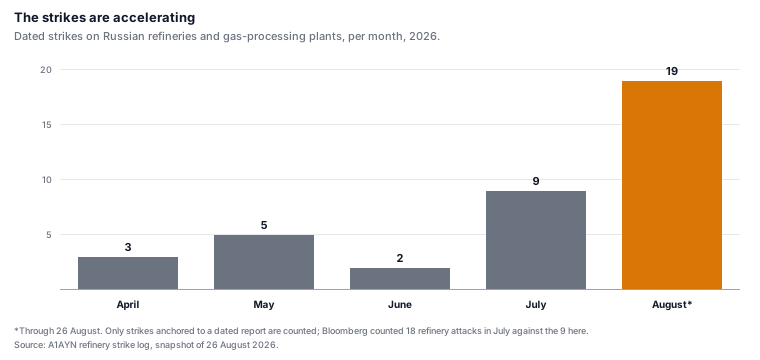
The tracker dates thirty-eight strikes on twenty-two Russian refineries and gas-processing plants since mid-April: three to five a month in the spring, nine in July, nineteen in August by the 26th [1]. The log undercounts by design, it records only strikes that can be anchored to a dated report, and Bloomberg counted eighteen refinery attacks in July alone against the nine dated here [1].
Ufa is the cleanest example of what I can establish from public sources and what I cannot. When drones reached the Bashneft complex on 19 August, Bashkortostan head Radiy Khabirov said workers were already repairing the unit the drones hit [2]. Ukrainian drones had also reached the complex on 1, 2 and 5 August [1][2]. Reporters have not identified which earlier attack caused the repair, nobody has established that the same unit was hit twice, and nobody has said how much of the plant was running on the morning of the latest strike.
From a second fire I can infer only a second fire, not a restart.
A refinery is not simply on or off: operators can return a crude unit while a secondary unit remains damaged, run the plant below its nameplate capacity, or flare during a shutdown, so a strike count describes the campaign without measuring the barrels Ukrainian forces removed. The gaps between strikes carry the same limit, they end when Ukrainian planners choose to return, not when Russian engineers finish a repair, so I do not read a return visit as proof that a plant had come back. This is the fog of war in the refinery business.
The barrels lost
Russian refineries processed an estimated 3.6 million barrels a day in July, the lowest level since May 2002 [3]. In the comparable part of 2020 to 2025, they processed about 5.3 to 5.6 million barrels a day. The difference is 1.7 to 2.0 million barrels a day.
Both of those numbers are estimates from the same commercial model: EA Analytics reconstructs Russian runs from satellite monitoring and cargo tracking because Moscow has classified the statistics [3]. The seasonal window is left undefined and the series gets revised, in mid-July the same analysts had the month running at 3.91 million barrels a day, so treat the band as one house’s reconstruction rather than a measurement. It cross-checks against the IEA’s June figure [3].
I cannot assign that whole difference to Ukrainian drones: maintenance, refinery economics, crude logistics and errors in the underlying estimate all move monthly runs. In July European low-sulphur gasoil futures traded at a record $74.66-a-barrel premium to Brent [10], though sanctions and the export bans muddy what a Russian refiner could earn from that, so the domestic evidence carries the argument: refiners do not voluntarily cut runs while fuel runs short at home, and by mid-August more than half of Russia’s regions restricted gasoline sales [7] while Russia imported gasoline from India [6]. The run cuts were not voluntary. If the attacks explain half of the shortfall, the implied loss is roughly 0.85 to 1.0 million barrels a day. That is a sensitivity case, not an estimate: the public evidence does not establish whether the attacks’ share sat below or above half. My own reading puts it above half, for a stated reason rather than a measured one: Russian operators were repairing a changing list of damaged units in a month when every working unit was needed.
The number I would like, days of throughput lost by unit, is the one nobody publishes, so the public evidence gives fragments instead. After a drone struck Orsk’s primary refining unit on 11 August, Orenburg governor Yevgeny Solntsev said repairs could take up to six months because the equipment was imported and sanctions made replacement difficult [4].
One governor’s estimate does not make a repair series, but it is the clearest public description of the constraint, that Russian engineers can repair steel and cannot quickly replace the specialised components that foreign suppliers no longer sell them, at least not openly.
Russia’s home market
By late August, Russian gasoline production had fallen to about 80,000 tonnes a day against summer demand of roughly 115,000, according to Reuters sources [8]. Domestic production was covering about 70% of demand. That is the trough rather than the month: August production averaged nearer 90,000 tonnes a day, and imports lifted total supply to about 85% of demand [8].
In July the government banned gasoline exports for all sellers and diesel exports for resellers through January 2027, with exceptions for intergovernmental agreements and humanitarian shipments [5], and on 29 August, as this brief was being finished, it extended the producer ban on diesel, marine fuel and gasoil through 30 September, cancelling a carveout that would have freed producer diesel exports from 1 September [17]. Russian importers received a gasoline cargo from India, an unusual direction of trade for the world’s third-largest refined-product exporter [6]. The BenZinMap price portal counted gasoline sales restrictions by 15 August in 58 of the 89 regions on Moscow’s own map, annexed territories included [7], a portal’s tally rather than an official census.
None of these facts alone proves systemic failure, but they run in one direction: when output fell, officials gave up export revenue to defend the home market, naturally limiting global supply.
The buyers of Russian products
Russian seaborne product exports fell to 3.93 million tonnes in July, 54.7% below the same month a year earlier, with average daily shipments down 33.3% from June [9]. Diesel and gasoil shipments fell about 60% from June, to roughly 750,000 tonnes [9].
Damaged units made less product, summer demand pulled more of what remained into the home market, and the export restrictions then walled off most of the rest, so the drones do not get sole credit for the export numbers. Nor do the three causes compete cleanly: officials extended the restrictions as domestic supplies tightened, which puts the attacks at the start of the chain even where policy did the final cutting. Traders met the combination as one fact, fewer Russian cargoes.
The direct buyers have names, as the flows stood before the 2026 restrictions: Brazil took more Russian diesel than any other country, fuel oil went mainly to the Middle East and China, and naphtha to Taiwan [15]. The switch is already visible in Turkey: Russian fuel covered 85% of Turkish diesel imports in 2025 and about 20% of them in August, while Turkish imports from India and the United States rose to the highest in Kpler’s records [18]. Exposure does not stop with the direct buyers: when Russian shippers offer less diesel, importers turn to India, the Gulf, the United States and the other refining centres, where they queue behind established customers, and the importers with little storage, little domestic refining and a dependence on spot cargoes have the least room to wait.
July’s record diesel margin had more than one cause [10]: Aramco had shut its 400,000 barrel-a-day Jazan refinery after a Houthi attack, and operators at Kuwait’s 615,000 barrel-a-day Al-Zour refinery lost units on 18 July to a grid power cut, a day after Iranian attacks damaged Kuwaiti power and desalination plants, not from a strike on the refinery itself. I cannot assign the record to Russia; I can say that Russian shippers withdrew a large volume of diesel in the same weeks other refiners were also failing.
The global effect is narrower than “an energy crisis”: outside Russia, a price effect, not a shortage. When several refiners withdraw supply at once, importers bid against each other for the cargoes that remain, and the price of the next one rises. Distributors pass the increase to their customers: truckers, farmers, mines, construction firms, anyone running a backup generator, as I witnessed last week, a story worthy of another brief.
The satellite and its limitations
In the five days to 28 August, NASA sensors detected a thermal anomaly near seven of the fourteen Russian plants the tracker classified as offline [1][11], which I read not as seven restarts but as a reason to distrust any clean offline tally.
Russian operators may have restarted some plants partially, they may have flared during an upset, and at 375-metre resolution NASA may simply have seen another industrial source inside the same search box, so I use the signal to decide where to look again, not to manufacture a throughput estimate.
A gap runs through my own brief as well: reporters can verify a strike, satellites can detect heat, shipping data and aggregate runs can show lost product, and none of it, alone or together, lets me calculate how many barrels a named unit failed to produce on a named day. Where the evidence stops, I am left with a probable direction rather than a number.
Three scenarios, two predictions
The campaign moves from products to crude. Ukrainian planners have already widened the target set from refineries to the crude export system, Primorsk and Ust-Luga in March, the Sheskharis crude terminal at Novorossiysk in August [14]. If that becomes the main effort, the story changes from Russia short of products to the world short of Russian crude, and the price event moves from refining margins to crude itself. The marker is two consecutive monthly declines in combined crude loadings at Novorossiysk, Primorsk and Ust-Luga.
The slow strangle. Repairs, not strikes, set the pace. At Orsk the governor put repairs at up to six months for want of imported components [4]; if Orsk is representative, Russian repair crews cannot return capacity as quickly as Ukrainian forces damage it even if the strike tempo falls, and damaged capacity accumulates. The marker is two consecutive monthly increases in capacity at plants with verified outages, supported by falling aggregate runs, and repaired plants reappearing on the outage list.
The grey-market adaptation. Components reach Russia through intermediaries, air defence concentrates around the refineries that matter most, and the repair race stabilises. Runs recover, the export carveouts return, and the forward market turns out to have priced the damage correctly. The marker is runs rising above 3.8 million barrels a day, the producer ban lapsing, and the February crack settling at or below $58.
Against that range, two predictions. The first, dated and falsifiable: EA Analytics’ first-published monthly run estimates stay between 3.5 and 3.8 million barrels a day for September, October and November, and Russia keeps its producer ban on diesel, marine fuel and gasoil exports in force through 30 November. A monthly estimate outside that range, in either direction, or the ban lifting before December, proves the prediction wrong; I will score runs against first-published figures, not later revisions, and say so here.
The second prediction is the risky one, because it says traders have underpriced winter diesel. The instrument is the European low-sulphur gasoil crack, the premium of ICE gasoil futures over Brent: a record $74.66 a barrel in July [10], around $95 at its August peak and near $78 in the month’s last week [16]. On 28 August the forward curve priced the February 2027 crack at roughly $58 a barrel, from February gasoil near $1,051 a tonne against February Brent near $82.50, at ICE’s 7.45 barrels to the tonne [16]. My call is that February settles above that $58: Russian runs sit near a 24-year low [3], the producer export ban has just been extended again [17], the clearest public repair estimate runs to six months [4], and I do not think traders have fully priced those constraints into the curve. February at or below $58, scored by the formula in [16], proves me wrong.
For people getting excited about a video clip of a refinery in flames: ask whether there was any real damage, and maybe closer to home, ask how much more this will cost you in food and transportation.
For July, the best available estimates are these: Russian refineries processed 1.7 to 2.0 million barrels a day below their recent seasonal range, and Russian shippers exported about 60% less diesel and gasoil than in June. Ukrainian forces did not destroy Russian refining, but the attacks helped push Russia into fuel rationing and gasoline imports, while foreign buyers replaced the missing cargoes in an already tight refining market, at prices that pass into food and transportation.
That is enough to matter, not because the world runs out of oil, but because somebody still has to refine the next barrel and somebody has to pay for it.
References
[1] A1AYN refinery status tracker and strike log, snapshot of 26 August 2026. Thirty-eight dated strikes on twenty-two named Russian refining and gas-processing targets since mid-April: 3 in April, 5 in May, 2 in June, 9 in July and 19 in August through the 26th. Facility statuses combine primary reporting, wire reports and tagged Ukrainian or open-source claims. The log records only strikes anchored to a dated report and therefore undercounts: Bloomberg counted 18 refinery attacks in July against the 9 dated here. The page is live and moves past this snapshot; the figures in this brief are preserved in a frozen export at https://www.a1ayn.com/data/refineries/snapshot-2026-08-26.json. Live page: https://www.a1ayn.com/data/refineries/
[2] Charter97, 19 August 2026. Bashkortostan head Radiy Khabirov said workers were already repairing a unit struck at the Ufa refining complex. The report does not identify which earlier incident caused the repair. https://charter97.org/en/news/2026/8/19/695277
[3] The Moscow Times, 3 August 2026, reporting Bloomberg and EA Analytics data; Bloomberg via Rigzone, 13 July 2026. The August piece: an estimated 3.6 million barrels a day in July, the lowest since May 2002, against approximately 5.3 to 5.6 million barrels a day in the same period of 2020 to 2025, with the seasonal window left undefined. The July piece carries the methodology (EA Analytics estimates runs from satellite tracking of fields and storage plus real-time cargo flows), the mid-July estimate of 3.91 million barrels a day, and the IEA cross-check of 3.8 million barrels a day for June, 1.6 million below a year earlier. Russia has classified its refinery statistics; none of these figures is published data. https://www.themoscowtimes.com/2026/08/03/russian-oil-refining-falls-to-24-year-low-after-ukrainian-drone-strikes-bloomberg-a93404 and https://www.rigzone.com/news/wire/russian_refinery_runs_plunge_to_lowest_in_more_than_2_decades-13-jul-2026-184123-article/
[4] Meduza, 13 August 2026. Orenburg governor Yevgeny Solntsev said imported equipment and international sanctions could extend repairs at the Orsk refinery to six months. https://meduza.io/amp/en/news/2026/08/13/ukrainian-drone-strike-fully-shuts-down-oil-refinery-russia-s-orsk-governor-says-repairs-could-take-6-months
[5] The Moscow Times, 30 July 2026. Russia extended gasoline and diesel export restrictions through January 2027, with specified exceptions. Its carveout would have freed producer diesel exports from 1 September; that carveout was cancelled on 29 August, see [17]. https://www.themoscowtimes.com/2026/07/30/russia-extends-gasoline-and-diesel-export-ban-through-january-2027-a93382
[6] The Moscow Times, citing Kpler shipping data, 12 August 2026. Russia received its first reported gasoline cargo from India amid domestic shortages. The report describes Russia as the world’s third-largest exporter of refined petroleum products. https://www.themoscowtimes.com/2026/08/12/russia-forced-to-import-gasoline-from-india-amid-domestic-shortages-a93466
[7] Govorit NeMoskva, 23 August 2026, citing the BenZinMap portal. Gasoline sales restrictions in place by 15 August in 58 of 89 regions, with localised outages or price rises in a further 18. The 89-region count is Moscow’s, including annexed territories; the tally is the portal’s, not an official census. https://nemoskva.net/en/2026/08/23/defitsit-benzina-rossiya-eksport-ogranicheniya-regiony/
[8] Reuters, 28 August 2026. Two industry sources estimated Russian gasoline production at about 80,000 tonnes a day in late August against demand of approximately 115,000 tonnes, covering about 70%; the same report puts August average production nearer 90,000 tonnes a day and total supply including imports at about 85% of demand. Russia’s Energy Ministry stopped publishing motor-fuel output data in 2024, so these are estimates. https://www.reuters.com/business/energy/russias-gasoline-output-drops-70-domestic-demand-late-august-after-drone-attacks-2026-08-28/
[9] Reuters, 4 and 13 August 2026. July seaborne oil-product exports of 3.93 million tonnes, 54.7% below July 2025, with average daily shipments down 33.3% from June; diesel and gasoil down about 60% from June to roughly 750,000 tonnes. Attributed by Reuters to industry sources and its own calculations rather than to a named cargo tracker. Note the daily-average and total-volume figures are different measures. The 60% diesel figure is from the 4 August piece, the rest from 13 August. https://www.reuters.com/business/energy/russian-july-seaborne-oil-product-exports-drop-33-mm-data-sources-shows-2026-08-04/ and https://www.reuters.com/business/energy/russian-seaborne-oil-product-exports-dropped-33-july-data-sources-shows-2026-08-13/
[10] Reuters, 30 July 2026. The premium of European low-sulphur gasoil futures over crude extended its all-time high to $74.66 a barrel amid refinery disruptions in Russia and the Middle East. Gasoline’s premium was near a four-year high rather than any record and jet fuel was well below its March 2026 high, so the record is specific to gasoil. The same report covers the Jazan shutdown and the Al-Zour power cut; the Iranian attacks on Kuwaiti power and desalination plants of 17 to 18 July are reported separately (The National, 18 July 2026, https://www.thenationalnews.com/news/gulf/2026/07/18/iran-hits-second-power-and-water-plant-in-kuwait-after-another-night-of-us-strikes/). https://www.reuters.com/business/energy/refinery-attacks-keep-european-fuel-prices-around-record-highs-2026-07-30/
[11] NASA FIRMS, five-day window ending 28 August 2026, analysed through A1AYN’s thermal watcher. Seven of the fourteen Russian facilities the tracker classed as offline showed at least one thermal detection inside the defined search box; across all seventeen offline facilities on the tracker, Iranian, Saudi and Kuwaiti plants included, the count is nine. Thermal anomalies indicate heat, not refinery throughput. Method: VIIRS near-real-time detections from the S-NPP and NOAA-20 satellites, a 0.1 by 0.1 degree box centred on each facility (about five kilometres half-width in latitude), five-day query window, fetched 28 August. The facility-level detections are preserved in the frozen export under [1]. https://firms.modaps.eosdis.nasa.gov/
[12] Middle East Eye live blog, 28 July 2026. A single unattributed sentence reporting that Aramco had “reportedly suspended operations” at Abqaiq. No named source, agency or official. The attack itself was real: the Associated Press reported Planet Labs satellite imagery showing damage at the facility. As of 29 August 2026, I found no wire report or Saudi statement confirming an operations suspension. Abqaiq’s roughly 7 million barrel-a-day capacity per the EIA. https://www.middleeasteye.net/live-blog/live-blog-update/saudi-arabia-halt-operations-major-oil-facility-after-houthi-attack and https://www.pbs.org/newshour/world/iran-resumes-missile-attacks-as-u-s-and-saudis-strike-tehran-backed-militias-in-iraq and https://www.eia.gov/todayinenergy/detail.php?id=41413
[13] Bloomberg and contemporaneous price reporting, 27 July to 12 August 2026. Brent settled down 8.7% on Monday 27 July after Washington paused its air campaign against Iran, and fell a further 4.8% on 28 July. Saudi Arabia reported July output of 8.2 million barrels a day to OPEC, up from 7.1 million in June and still well below pre-conflict levels; Arab Light September pricing to Asia was cut by 50 cents to a $2 discount to the regional benchmark, the lowest since June 2020. The Brent settlements are from Reuters (27 July) and CNBC (28 July); the output and pricing from Bloomberg. https://www.bloomberg.com/news/articles/2026-08-12/saudis-report-million-barrel-output-rebound-in-july-to-opec and https://finance.yahoo.com/energy/articles/oil-slips-more-5-us-221044741.html and https://www.cnbc.com/2026/07/28/oil-price-today-wti-brent-us-iran-hormuz.html
[14] Bloomberg tanker-tracking, 7 July and 25 August 2026; KSE Russian Oil Tracker, July 2026; strike reporting, March and August 2026. Four-week average seaborne crude shipments reached 4.22 million barrels a day to 5 July, the highest since the 2022 invasion, as crude that could not be processed domestically was diverted to export. By the four weeks to 23 August, shipments had fallen for five consecutive weeks to about 3.46 million barrels a day, still close to the year-to-date average. The export infrastructure has been struck directly: Primorsk and Ust-Luga in late March (The Moscow Times), and the Sheskharis crude terminal at Novorossiysk on 11 to 12 August, after which crude loadings there were suspended (Reuters via Ukrainska Pravda). https://www.bloomberg.com/news/articles/2026-07-07/russia-s-record-oil-exports-can-t-outpace-tumbling-prices and https://www.energyconnects.com/news/gas-lng/2026/august/ukraines-double-barreled-drone-strikes-snarl-russian-oil-flows/ and https://kse.ua/about-the-school/news/russian-oil-tracker-july-2026-refinery-strikes-drove-oil-product-exports-to-a-record-low-while-the-diesel-and-gasoil-export-ban-could-put-up-to-36-of-total-oil-product-export-volumes-at-ri/ and https://www.themoscowtimes.com/2026/03/23/ukraine-strikes-primorsk-port-in-northwestern-russia-damaging-fuel-reservoirs-a92302 and https://www.pravda.com.ua/eng/news/2026/08/15/8048754/
[15] Energy Intelligence, 2025. Brazil is the largest single buyer of Russian diesel and gasoil; Russian fuel oil flows mainly to the Middle East and China, and naphtha to Taiwan. Destination pattern reported before the 2026 export restrictions. https://www.energyintel.com/0000019b-4c31-db2e-a5bb-ee33d5e70000
[16] ICE forward curves via TradingView, snapshot of 28 to 29 August 2026; ICE gasoil crack contract specification; crack-spread reporting, August 2026. February 2027 low-sulphur gasoil around $1,051 a tonne against February 2027 Brent around $82.50 a barrel; ICE’s published conversion factor is 7.45 barrels per tonne, so the implied February crack is roughly ($1,051 / 7.45) minus $82.50, about $58.6 a barrel. That figure is this brief’s derivation from the two curve legs, not a published number. Scoring: the February prediction is judged as (February 2027 gasoil final settlement in dollars a tonne divided by 7.45) minus the February 2027 Brent final settlement, against the $58.6 benchmark above. Spot northwest-European gasoil cracks peaked near $95 a barrel in mid-August and stood near $78 in the month’s last week. https://www.tradingview.com/symbols/ICEEUR-ULS1!/contracts/ and https://www.tradingview.com/symbols/ICEEUR-BRN1!/contracts/ and https://www.ice.com/products/6753331/Gasoil-Crack-Low-Sulphur-Gasoil-1st-Line-vs-Brent-1st-Line-Future-in-Bbls and https://energynewsbeat.co/downstream/asia-europe-and-us-diesel-crack-spreads-are-on-fire-what-does-this-mean-for-consumers-and-investors/
[17] Reuters and Bloomberg, 29 August 2026; Interfax, 30 July 2026 for the decree’s original scope. Russia extended the ban on diesel, marine fuel and gasoil exports by producers through 30 September, cancelling the 30 July decree’s carveout that would have freed producer diesel exports from 1 September. Gasoline exports by all parties and diesel exports by non-producers remain banned through 31 January 2027. https://www.reuters.com/business/energy/russia-extends-ban-diesel-exports-until-september-30-2026-08-29/ and https://interfax.com/newsroom/top-stories/118566/ and https://www.bloomberg.com/news/articles/2026-08-29/russia-extends-diesel-export-ban-as-ukraine-ramps-up-attacks
[18] Reuters, 27 August 2026, citing Kpler data. Russia supplied 85% of Turkey’s diesel imports in 2025, about 281,000 barrels a day; its share fell to about 20% in August 2026, while Turkish imports from India (over 120,000 barrels a day) and the United States (about 90,000) were the highest in Kpler’s records, which reach back to 2017. Energy Aspects frames the same flows as the highest since 2022 and 2019 respectively. https://www.reuters.com/business/energy/turkey-boosts-diesel-imports-us-india-after-russia-ban-prompts-diversification-2026-08-27/ and https://www.dailysabah.com/business/economy/turkiyes-diesel-imports-from-us-india-hit-record-high-after-russia-ban
Strike dates and facility statuses are drawn from A1AYN’s curated record, re-verified against available reporting on 26 August 2026. Each facility is tagged by evidence class. Ukrainian military and open-source claims are not treated as equivalent to wire-confirmed outages. The strike log records only strikes that can be anchored to a dated report and therefore undercounts. Satellite thermal detections are corroborating evidence only and are not converted into throughput estimates.