On 29 April 2024 at nine in the evening, Thai electricity demand set its record: 36,699 MW, in an extreme heatwave [9]. The sun over Bangkok had set two and a half hours earlier. Every solar panel in the country was producing nothing, and the record hour was carried mostly by gas, coal, hydro and imports. Whether solar and batteries can push LNG cargoes out of Thailand’s fuel bill is, compressed into one hour, the question of what serves nine o’clock.
This brief is the sequel to the cost of Thailand’s LNG dependence, which ended at 2028: Yadana’s export contract expires that year, the mature Gulf fields are declining, and the gap since January 2024 has been covered by LNG, the most expensive gas Thailand buys. The question here is the way out. Wind, geothermal and wave power get their honest paragraph below, and the answer they add up to is the one the reader suspects: solar with batteries is the only domestic candidate at the required scale, and it comes with three caveats that are the real subject of this brief. Battery chemistry, cost floors and the storage-duration problem live on the battery technologies page; live Thai gas supply by field sits at /data/pipelines/, and the Thai market layer at /data/thailand/.
Gas flows below are in the industry’s unit, million standard cubic feet per day (mmscfd). Two conversions run through this brief: a standard LNG carrier regasifies to about 3.7 billion cubic feet, so a flow of ten mmscfd held for a year is one cargo; and burned in a new combined-cycle plant at 7,000 BTU per kWh, one cargo makes about half a terawatt-hour of electricity.
The arithmetic that changed
In May 2022 Thailand’s National Energy Policy Council fixed feed-in tariffs for a 5.2 GW renewable procurement: 2.17 baht per kWh for ground-mounted solar, 2.83 baht for solar with a battery attached, 3.10 baht for wind, locked for 25-year terms; the Energy Regulatory Commission selected 175 projects totalling 4,852 MW in April 2023 [3][4]. What makes those tariffs matter is the other column.
In May 2026, EPPO’s pool price for LNG was 524 baht per MMBtu, against 362 for the blended pool and 183 for gas from Thailand’s own Gulf fields [2]. Burn that LNG in a new combined-cycle plant at 6,500 to 7,500 BTU per kWh, a deliberately efficient assumption, and the fuel alone costs 3.41 to 3.93 baht per kWh. No plant, no operations, no capacity payment, no wires: fuel.
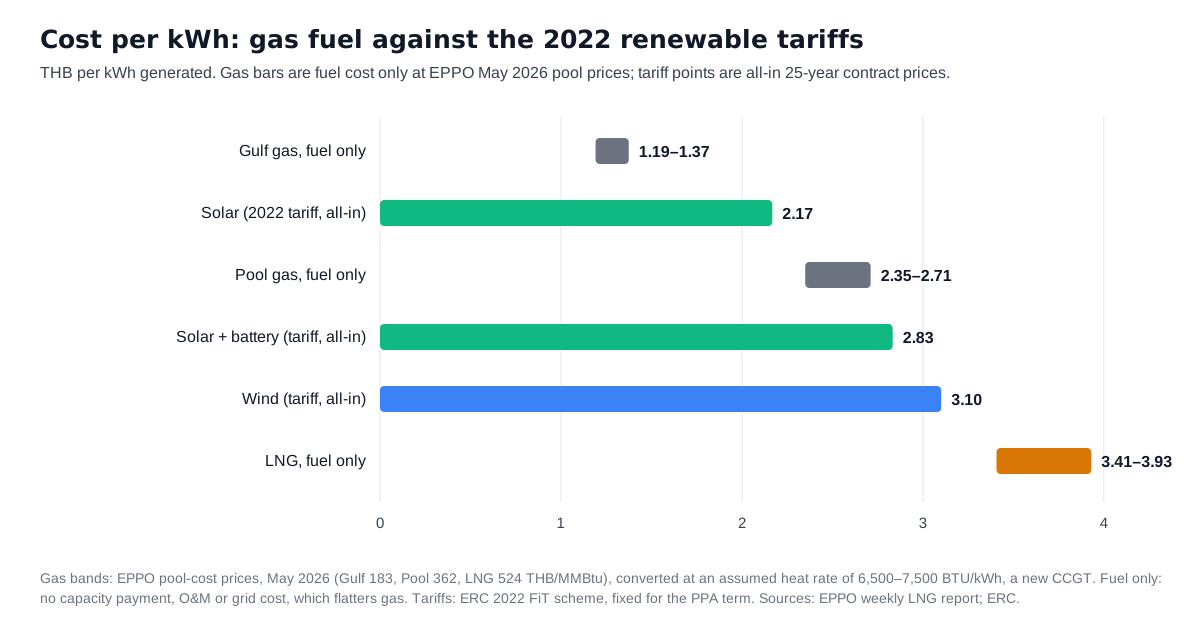
The tariffs are all-in prices, covering the panels, the land, the inverters, the battery and the developer’s return for 25 years; the gas bars cover the molecule and nothing else. The comparison is lopsided in gas’s favour, and solar still wins it. A kWh from a new solar-plus-battery plant, complete, was contracted below the bare fuel cost of an LNG-fired kWh at May 2026 pool-cost prices, before counting a single baht of the power station that burns it [2][3]. Solar without the battery, at 2.17, sits below the fuel cost of the blended pool.
Gulf gas at 1.19 to 1.37 baht per kWh is the reason Thailand built a gas system in the first place, and against that fuel solar does not win on cost: the 2.17 all-in tariff sits above the fuel-only band. The question is which row is real at the margin. Domestic fields ran at 3,095 mmscfd in May 2026 and are declining; the fields’ output is committed, and every incremental unit of demand, every field outage, every dry year in the hydro reservoirs is met at the margin by the 524-baht molecule, not the 183-baht one [1][2]. Thai generators pay the pooled price, not the LNG price: since March 2024 the regulator’s energy price for the power pool has been the Pool Gas average, 362 baht in May [2][17]. Pooling changes who sees the cost, not what the system buys. Where gas is the plant a solar kWh backs down, and the domestic fields are committed, the avoided fuel is LNG, not the pool average. A solar kWh does not displace the average molecule. It displaces the marginal one, and the marginal one arrives by ship.
Daylight and the night
Thai solar generation rose 72% in 2025, to 9 TWh, 5% of generation [8]. Every one of those kWh landed between roughly seven in the morning and six in the evening. The record demand hour sits at 21:00 [9]. That gap, two and a half hours wide on the record day, is a product specification.
The 2.83-baht contract specifies the battery’s job precisely: full contracted capacity from nine in the morning to four in the afternoon, and 60% of contracted capacity between 18:01 and six in the morning, for two hours at least, longer if the offtaker orders it [3]. That is a partial-firm product with a two-hour minimum. Most grid batteries worldwide still run about two hours; the average duration commissioned in 2025 reached three, four-hour systems are the growing end of the market, and LFP is about 90% of deployments, the chemistry whose mineral floor carries no nickel and no cobalt [16]. Thailand’s storage problem is short-duration by construction: the Finnish duration wall is 154 consecutive hours of wind below a tenth of its peak, while a tropical solar system faces a nightly gap of known length and a wet season of reduced but never absent output. What the 2022 price proves is that developers accepted a two-hour-minimum evening obligation at 2.83 baht. Whether the Thai evening ramp needs two hours or four is a sizing question the 2022 terms do not answer.
What the two-to-four-hour products the market ships do not solve is the full night. Solar with four hours of storage, the sizing NREL uses as its utility-scale benchmark, covers demand to roughly ten or eleven in the evening [16]. The hours from then to sunrise still belong to firm capacity: gas, coal, hydro, imports. The realistic ambition for the 2020s is not a solar-powered 3 a.m. It is pushing gas out of the day and out of the evening peak, the hours when the pool leans hardest on its marginal fuel [1][2].
The scale wall
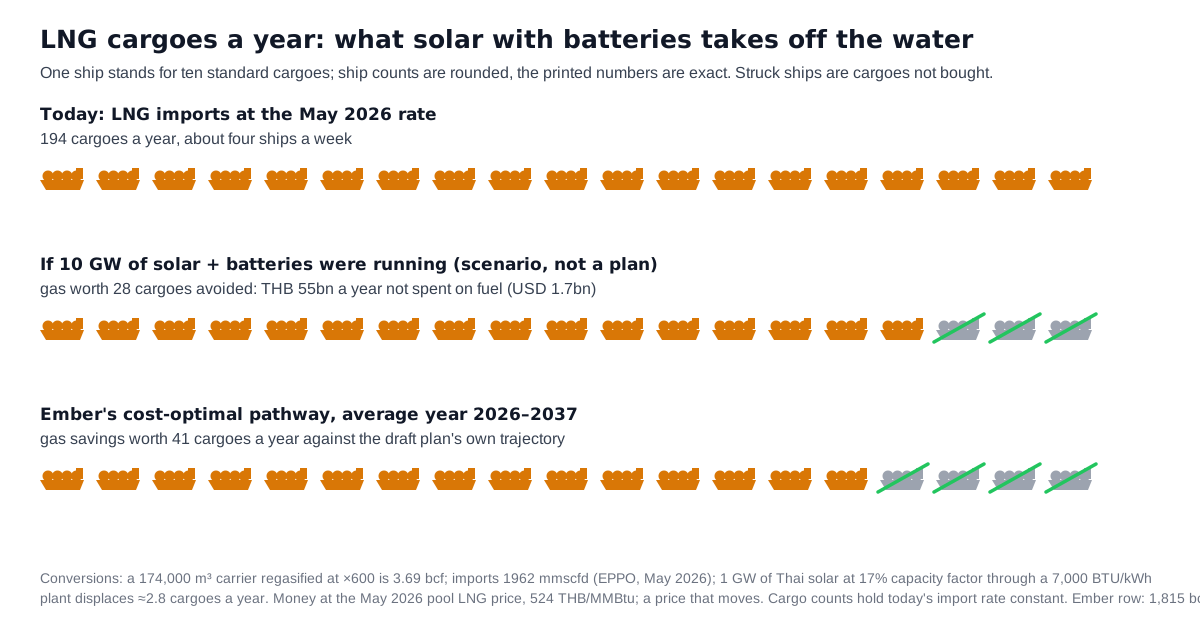
Displacement arithmetic, this brief’s own, with the assumptions stated: a gigawatt of Thai solar at a 17% capacity factor produces about 1.5 TWh a year. Burned through a 7,000 BTU-per-kWh plant, the same electricity would take about 28 mmscfd of gas, nearly three cargoes a year. At the May 2026 LNG pool price, 28 mmscfd is about 5.5 billion baht a year, USD 168 million, of cargoes not bought [1][2]. The 2025 solar increment alone, 3.8 TWh, was on this arithmetic worth roughly 73 mmscfd, seven cargoes a year, about four percent of the LNG Thailand landed in May [1][8].
LNG imports in May 2026 were 1,962 mmscfd, about 194 cargoes a year; burned through the same plants, that is roughly 100 TWh of electricity, against national generation of about 180 TWh [1][8]. At 28 mmscfd per gigawatt, matching that flow on annual energy alone is a seventy-gigawatt project, ten times the fleet that stood at 6.8 GW in national statistics this year [12]. And no solar fleet reaches all of it: power stations take about three-fifths of Thailand’s gas, and the rest burns or is processed in industry and the separation plants [1].
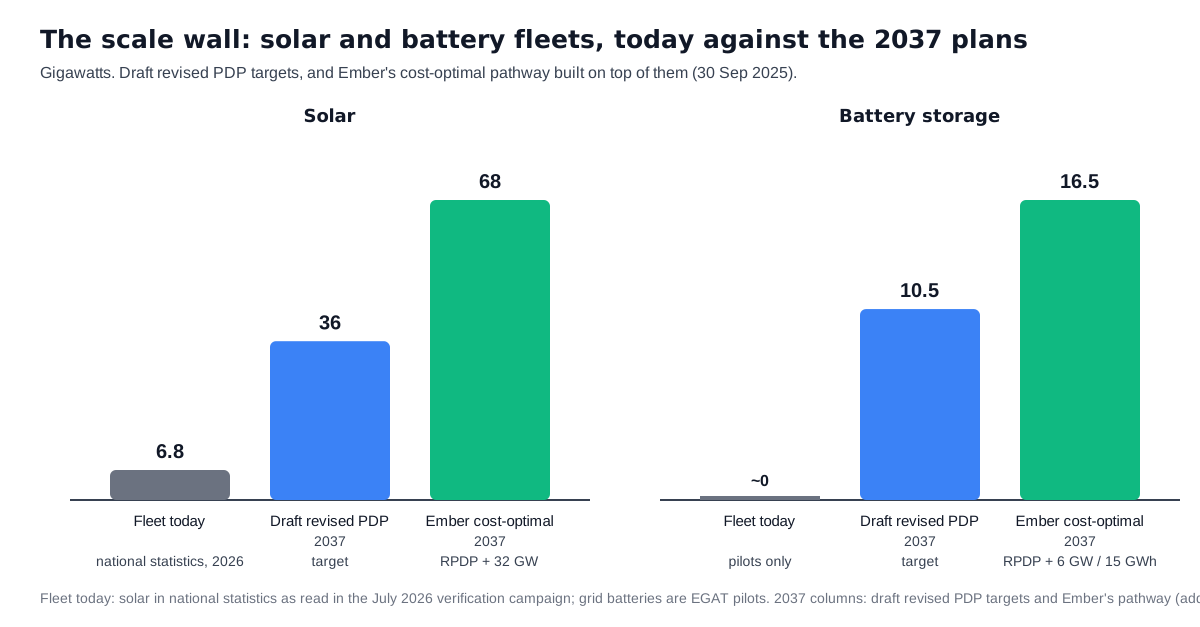
The draft revised Power Development Plan already targets 36 GW of solar and 10.5 GW of battery storage by 2037; the plan in legal force is still PDP2018 Revision 1, drafting has moved to a successor, PDP2026, with its public hearing set for August 2026, and the successor again carries a 10.5 GW battery figure, on a horizon now stretched to 2050 [7][13][18]. Ember, modelling in September 2025 on the then-current draft’s assumptions, found the cost-optimal fleet is larger still: 32 GW more solar and another 6 GW / 15 GWh of batteries, 2 GW less new gas capacity, and 11% less gas burned in the power sector over 2026 to 2037 [7]. Averaged over the period, that saving is roughly 415 mmscfd, about 41 cargoes a year, a fifth of current LNG imports, and it is the increment beyond a draft plan that already puts more than five times today’s fleet on the books.
The first round selected 4,852 MW in April 2023; the additional 3,668.5 MW round was deferred whole by the National Energy Policy Council in December 2024, and in May 2025 the council shelved the unexecuted 1,488.5 MW pending the new plan and sent the selected 2,145.4 MW to price renegotiation [4][5]. At that cadence the 2037 targets require an acceleration that nothing between selection and signed PPA yet shows. The constraint on Thai solar has not been cost since 2022. It is throughput.
At the May 2026 rate the cargoes arrive about four ships a week [1]. Ten gigawatts of solar with batteries, the pace Scenario A below assumes, is on this arithmetic worth about 28 of those ships a year, THB 55 billion of fuel at the May pool price; Ember’s full pathway saves gas worth about 41 cargoes a year against the draft plan’s own trajectory through 2037 [7].
The caveats that bind
The first caveat is the grid bill: the cost-optimal pathway carries higher fixed expenditure than the draft plan, USD 168 billion against 153 billion over 2024 to 2037 [7]. The 1.8 billion of net saving is 17 billion of avoided fuel and variable running cost set against 15.2 billion of extra fixed spend [7]. Solar and batteries front-load capital and back-load the payoff; the transmission to move midday solar from the northeast to Bangkok, the substations, the firming reserve are all paid for before the first avoided cargo. A finance ministry watching the current account sees the LNG bill fall; a utility treasurer sees the debt rise first. Both are looking at the same plan.
The second is the contract stock. Thailand runs about 40,300 MW of gas-fired capacity [10], and in 2025 seven private plants totalling over 11 GW ran below a tenth of their capacity while being paid availability [19]. Those availability payments do not fall when dispatch falls; they are the contracted floor of the system, and every new solar kWh spreads the same fixed baht over fewer gas kWh. The payments sit in the base tariff, 0.63 baht per kWh in EGAT’s estimate for early 2026, six times the Ft line itself [19]. Nothing about that is an argument against building solar. It is an argument that the retail tariff will carry the old system’s fixed costs and the new system’s capital costs simultaneously through the transition, which is a political exposure.
The third caveat is the machinery itself: standalone batteries have no procurement route yet, the storage Thailand has contracted is the solar-attached kind, and the grid battery fleet is pilots [11]. The 994 MW of solar-plus-storage selected in the first round was contracted but the second round is still in negotiation, the direct-PPA pilot that would let data centres contract 2,000 MW of renewables through third-party grid access was approved in June 2024, widened beyond data centres by the NEPC in July 2026, and its access code is still in public consultation [5][6][14]. Every path to a big Thai battery fleet runs through a regulatory instrument that is, in August 2026, unfinished.
The also-rans, honestly
Wind was contracted in the same 2022 round at 3.10 baht [3], below LNG fuel cost. The problem is the resource, not the price: Thai wind speeds are low, so a turbine there produces far fewer hours a year than the same machine in Vietnam or Denmark, and when Ember’s least-cost model was free to build whatever met demand most cheaply, it filled the plan with solar and batteries and left wind nearly alone [7]. The 2022 wind awards were also the part of the round a court injunction suspended, one cause of the stalled follow-up round [6]. Wind contributes, and it does not scale.
EGAT’s binary-cycle plant at Fang has run since 1989 at 300 kW, producing 150 to 250 kW with the season, and it remains the country’s only geothermal station [15]. As a national resource, geothermal is a rounding error with a long service record. Wave and tidal join it in the category of the contested seabed in the previous brief: theoretically present, practically absent from any 2020s balance.
EGAT already contracts Lao dams, more are building against its power purchase agreements, and the previous brief’s construction watch tracks them [12]. Hydro imports are the one alternative with real scale, and they are the incumbent’s tool. They are firm-ish, they serve the evening, and they come with a transmission dependency and a neighbour’s politics attached. They compete with batteries for the same evening hours, and the battery cost curve is read in Vientiane as closely as in Bangkok.
Three scenarios for 2026–2030
The framing below is this analyst’s reading of the alignment, not a quantitative forecast.
Scenario A: the machinery catches up. The revised PDP is approved with targets at or above the current draft, the deferred 3.7 GW round closes at renegotiated tariffs, the direct-PPA code is finished and data centres begin contracting against it. Solar additions run at several GW a year by 2028, ten gigawatts cumulative by the turn of the decade, each GW clipping, on this brief’s arithmetic, roughly 28 mmscfd off marginal gas demand just as Yadana’s contract reaches its 2028 end. LNG volumes plateau; the bill still swings with world prices, but on a shrinking base. This is the trajectory the tariff economics have supported since 2022; what it requires is administrative, not technological.
Scenario B: the gap arrives first. Court challenges and deferrals continue to hold the procurement pipeline to a trickle, the PDP revision slips again, and Yadana’s remaining volume, about 160 mmscfd, sixteen cargoes a year, ends in 2028 while the mature Gulf fields keep declining, in a gas system whose only flexible supply at scale is the LNG terminal. Imports grind higher, the tariff carries it, and the political response is pressure on tariffs rather than acceleration of the alternative. The record of 2024 to 2026, two deferred years, makes this the base case until a round actually closes.
Scenario C: demand outruns everything. Data centres add Ember’s high-case 10 TWh of annual demand and EV charging adds 3.3 GW to the system peak by 2037, and both solar and LNG grow together: solar takes the day, gas the night, and total gas burn falls slowly or not at all even as the solar fleet triples. Thailand’s LNG exposure becomes a floor, not a peak. Plausible if Bangkok wins the regional data-centre contest it is bidding for; the direct-PPA pilot exists precisely because those buyers demand clean supply.
Implications
For Thai energy planning: since 2022 the tariff schedule has priced solar with an evening battery obligation, at 2.83 baht, below the bare fuel cost of LNG generation. The binding constraints are procurement cadence, an unfinished access code, and transmission capital, all of which are decisions rather than discoveries.
For industrial buyers and data centres, the direct PPA is the instrument to watch. The 2,000 MW data-centre pilot of June 2024 was the single-buyer model’s first exception, created for customers who will not site capacity behind a gas-heavy grid; on 15 July 2026 the NEPC removed the ceiling and opened the mechanism to other industries needing clean supply, and the revised framework entered the legally required public consultation in August [14]. The pressure now runs both ways: by August 2026 approvals for new data centres had slowed over power and water limits, and a separate data-centre tariff was approved in principle to carry the grid investment they require [20].
For LNG sellers, Thailand remains a large LNG market through 2028 in every scenario above; growth after that is policy-dependent. The cargoes that cover Yadana’s decline put a floor under the near-term cargo count. The cargoes above that floor are priced against a 2.83-baht contract that does not move with Brent, Henry Hub or the JKM marker, and every deferred round extends their life.
EGAT will serve nine o’clock either way. The open question is whether that hour is powered by a cargo at a price set in a market Thailand does not influence, or by the previous afternoon’s sunshine at a price fixed in Bangkok for 25 years. Physics permits either; the choice sits with the officials who set the procurement calendar. The economics have been on the books since the 2022 tariff. What has been built since shows the machinery still delivers the cargo.
References
[1] EPPO, Ministry of Energy, Thailand, tables T03_01_01 and T03_02_02 (monthly, to May 2026). Natural gas production, imports by source and consumption by sector; snapshot in the site’s data layer, src/data/gas/thailand_eppo.json. https://www.eppo.go.th/data-energy-statistic/energy-statistic/gas-energy-stat/
[2] EPPO, weekly LNG situation report (edition 20–24 July 2026). Pool-cost prices by source, May 2026 column: Gulf gas 183.29, Myanmar 306.04, LNG 524.14, published pool 361.52 baht per MMBtu; THB/USD 32.53. Transcribed in the site’s data layer, src/data/thailand/energy_sankey.js; report series on EPPO’s statistics pages. https://www.eppo.go.th/data-energy-statistic/energy-statistic/gas-energy-stat/
[3] Energy Regulatory Commission (Thailand), 2022 feed-in tariff scheme for renewable power procurement (Big Lot). FiT rates 2.1679 THB/kWh ground-mount solar, 2.8331 solar with BESS, 3.1014 wind, fixed by NEPC resolution of 6 May 2022; 25-year PPA terms. The solar-BESS product is partial firm: 100% of contracted capacity 09:00–16:00 and 60% of contracted capacity between 18:01 and 06:00 for at least two hours, more as ordered by the offtaker. A FiT premium of THB 0.50/kWh applies only to projects in the southern border provinces (Yala, Pattani, Narathiwat and the Chana, Thepha, Saba Yoi and Na Thawi districts of Songkhla). Summarised in Hunton client alert, October 2022, and Watson Farley & Williams, 12 October 2022. https://www.hunton.com/media/legal/87524_Client_Alert_ERC_Big_Lot_Program_20_Oct_2022.pdf and https://www.wfw.com/articles/thailands-5-gw-renewable-ppa-fit-scheme-2022-2030/
[4] ERC selection of first-round projects (meeting 17/2566, 5 April 2023). 175 projects totalling 4,852.26 MW against the 5,203 MW target: ground solar 2,368 MW, solar with BESS 994.06 MW, wind 1,490.2 MW; biogas received no awards. Reported by InfoQuest, 5 April 2023. https://www.infoquest.co.th/2023/290734
[5] Watson Farley & Williams, Thailand’s ERC revises PPA timeline for renewable procurement under FiT scheme (29 July 2025). Second round 3,668.5 MW deferred whole by NEPC resolution 25 December 2024; on 6 May 2025 the NEPC shelved the unexecuted 1,488.5 MW pending the new PDP and directed price renegotiation for the 2,180 MW reserved-quota envelope, within which 72 projects totalling 2,145.4 MW had been selected in December 2024; the split is reported by ThaiPublica, 6 May 2025. https://www.wfw.com/articles/thailands-erc-revises-ppa-timeline-for-renewable-procurement-under-fit-scheme/ and https://thaipublica.org/2025/05/eppo-agrees-to-delay-purchasing-more-electricity-from-renewable-energy/
[6] The Nation (Thailand), court issues injunction suspending energy regulator’s list of wind-power suppliers. The legal challenge that slowed round 2. https://www.nationthailand.com/thailand/general/40031941
[7] Ember, Thailand’s cost-optimal pathway (30 September 2025). Draft revised PDP targets 36 GW solar and 10.5 GW storage by 2037; cost-optimal pathway adds 32 GW solar and 6 GW / 15 GWh storage, cuts 2 GW of new gas capacity and 1,815 bcf of power-sector gas use 2026–2037; fixed expenditure USD 168bn vs 153bn; net saving USD 1.8bn; wind potential limited. https://ember-energy.org/latest-updates/adding-solar-and-battery-capacity-beyond-existing-targets-can-help-thailand-save-1-8-billion-in-power-generation-costs-between-2026-and-2037/
[8] Ember, Global Electricity Review 2026, Thailand. Solar generation 9 TWh in 2025, up 72%, 5% of the mix; gas above half of generation. https://ember-energy.org/data/electricity-data-explorer/
[9] The Nation, April 29 sees record electricity usage in Thailand as the heat bites (April 2024), and Energy-Box. System peak 36,699.9 MW on 29 April 2024 at 21:00, on the ERC Office’s three-utility system basis, at night when solar plants could not supply the system. https://www.nationthailand.com/sustaination/40037782 and https://www.energy-box.com/post/thailand-s-electricity-consumption-has-reached-an-all-time-high-for-the-third-time-while-the-electr
[10] The cost of Thailand’s LNG dependence (this site, 3 August 2026). Gas fleet 40,300 MW; LNG bill THB 102.7bn January–May 2026. https://www.a1ayn.com/blog/thailand-lng-dependence/
[11] Energy-Storage.news, Thailand’s energy storage market lags despite renewable push. The state of the Thai grid-battery fleet. https://www.energy-storage.news/thailands-energy-storage-market-lags-despite-renewable-push-and-upstream-manufacturing-support/
[12] A1AYN Thailand power construction watch (July 2026 verification campaign). Solar fleet 6,840 MW in national statistics; Lao dams building against EGAT PPAs. https://www.a1ayn.com/data/thailand/
[13] EPPO, Power Development Plan page. The plan in force is PDP2018 Revision 1 (2018–2037), approved by the NEPC on 19 March 2020 and Cabinet on 20 October 2020; the revised plan remains in draft. https://www.eppo.go.th/plan-policy/energy-plan/energy-plan-pdp/
[14] Hunton, Thailand’s draft regulation on direct power purchase agreements via third-party access for data centers, and Nation Thailand (July–August 2026). 2,000 MW pilot approved by NEPC 25 June 2024; on 15 July 2026 the NEPC removed the ceiling and extended direct PPAs beyond data centres to other industries; the revised framework entered the legally required public consultation after government approval on 3 August 2026. https://www.hunton.com/insights/legal/thailands-draft-regulation-on-direct-power-purchase-agreements-via-third-party-access-for-data-centers and https://www.nationthailand.com/news/general/40069791
[15] Springer, Geologic framework of the Fang Hot Springs area (2017). The 300 kW binary-cycle plant at Fang, operating since 1989, output 150–250 kW by season, Thailand’s only geothermal station. https://link.springer.com/article/10.1186/s40517-017-0087-7
[16] IEA, Global Energy Review 2026, battery storage chapter, and IEA commentary of 29 May 2026. Most grid battery projects run about two hours; the average duration of projects commissioned in 2025 reached three hours; LFP about 90% of deployments. NREL’s Annual Technology Baseline models the four-hour utility-scale system as its benchmark. https://www.iea.org/reports/global-energy-review-2026/technology-battery-storage, https://www.iea.org/commentaries/battery-storage-is-scaling-up-and-taking-on-a-larger-system-role and https://atb.nrel.gov/electricity/2024/utility-scale_battery_storage
[17] ERC (Thailand), Energy Pool Price. From March 2024, absent fuel-oil substitution for spot LNG, the Energy Pool Price equals the Pool Gas price calculated by the Pool Manager. https://www.erc.or.th/th/energy-pool-price
[18] Thai PBS Policy Watch, PDP2026 (5 July 2026), and RECCESSARY (29 June 2026). Draft PDP2026 spans 2026–2050, public hearing set for August 2026, NEPC approval expected in Q4 2026; the draft carries 10,485 MW of BESS. https://policywatch.thaipbs.or.th/article/economy-270 and https://www.reccessary.com/en/news/thailand-pdp-2026
[19] IEEFA, Thailand’s gas conundrum: overbuilt, underutilized, and increasingly expensive (26 February 2026). In 2025 seven privately owned gas plants totalling over 11 GW ran below a 10% capacity factor; availability payments sit in the base tariff at THB 0.63/kWh in EGAT’s estimate for the first 2026 cycle, against an Ft of THB 0.0972/kWh. https://ieefa.org/resources/thailands-gas-conundrum-overbuilt-underutilized-and-increasingly-expensive
[20] Bangkok Post, Data centre growth meets resource limits (August 2026), and Nation Thailand, Thailand plans stricter data centre rules over power and water use (August 2026). Power and water limits slow new data-centre approvals, developers queue for grid allocations, and a separate data-centre electricity tariff was approved in principle. https://www.bangkokpost.com/business/general/3298204/data-centre-growth-meets-resource-limits and https://www.nationthailand.com/news/general/40069408
Gas volumes and pool prices are EPPO monthly and weekly publications to May 2026, held in the site’s data layer. Fuel-cost conversions use this brief’s stated heat-rate assumption of 6,500–7,500 BTU/kWh, a new CCGT, which flatters gas; displacement arithmetic uses 7,000. The customs-basis LNG import values in the predecessor brief (THB 382–420/MMBtu) and the pool-cost prices used here (THB 524/MMBtu) are different bases and are never mixed in one figure. Displacement arithmetic assumes a 17% solar capacity factor and treats LNG as the marginal source of supply; generators pay the pooled average, and the pool average moves with every cargo. Cargo counts use a 174,000 m³ carrier regasified at ×600, about 3.7 bcf, and hold the May 2026 import rate constant; ten mmscfd held for a year is one cargo, about half a TWh of electricity at 7,000 BTU/kWh. Gas-volume conversions assume 1,000 BTU per standard cubic foot. The 0.50 southern-border FiT premium, where it applies, lifts solar with battery to 3.33 THB/kWh, still below the LNG fuel-only floor of 3.41. Displacement is annual-energy equivalence, gross of storage round-trip losses, curtailment and dispatch effects. National generation of roughly 180 TWh is derived from Ember’s 2025 figures, 9 TWh of solar at 5% of the mix. Ember’s 1,815 bcf gas saving over 2026–2037 averages 415 mmscfd.